

Indigenous Knowledge, Science & Culture
Introduction
Across Victoria, Aboriginal societies are structured through deep and enduring relationships to Country, family, and clan. These systems are among the oldest continuous cultural frameworks in the world, grounded in Lore, kinship, language, and ecological knowledge developed over tens of thousands of years. Clans are not simply social groupings—they are place-based communities connected to specific lands, waters, and skies, with defined responsibilities to care for Country and uphold cultural law across generations (Clark 1990; Broome 2005).
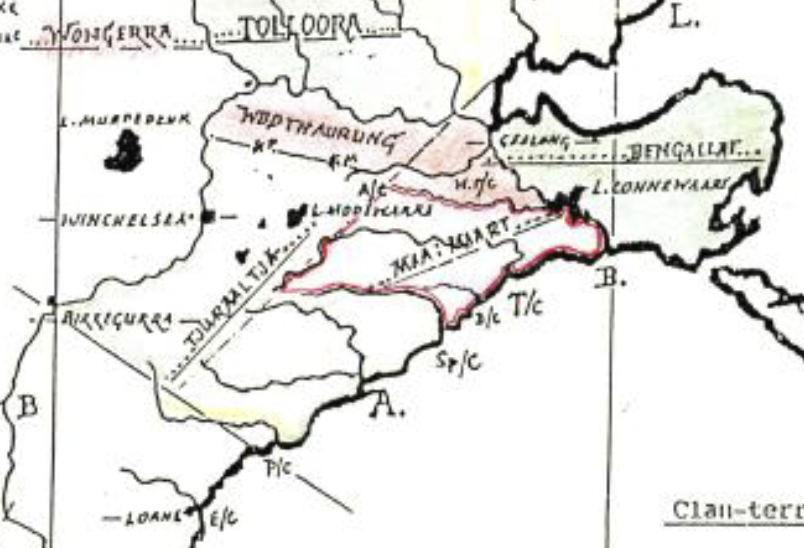
In Victoria, Aboriginal peoples belong to broader cultural groupings known as Nations, including the Kulin Nation in central and southern Victoria, alongside neighbouring Nations such as the Gunditjmara, Yorta Yorta, and others. Within the Kulin Nation are multiple language groups, including the Wadawurrung (also recorded historically as Wathaurong), Wurundjeri (Woiwurrung), Boonwurrung (Bunurong), Taungurung, and Dja Dja Wurrung. Each of these language groups is composed of clans associated with specific Countries and estates (Clark 1990; Blake & Reid 1998).
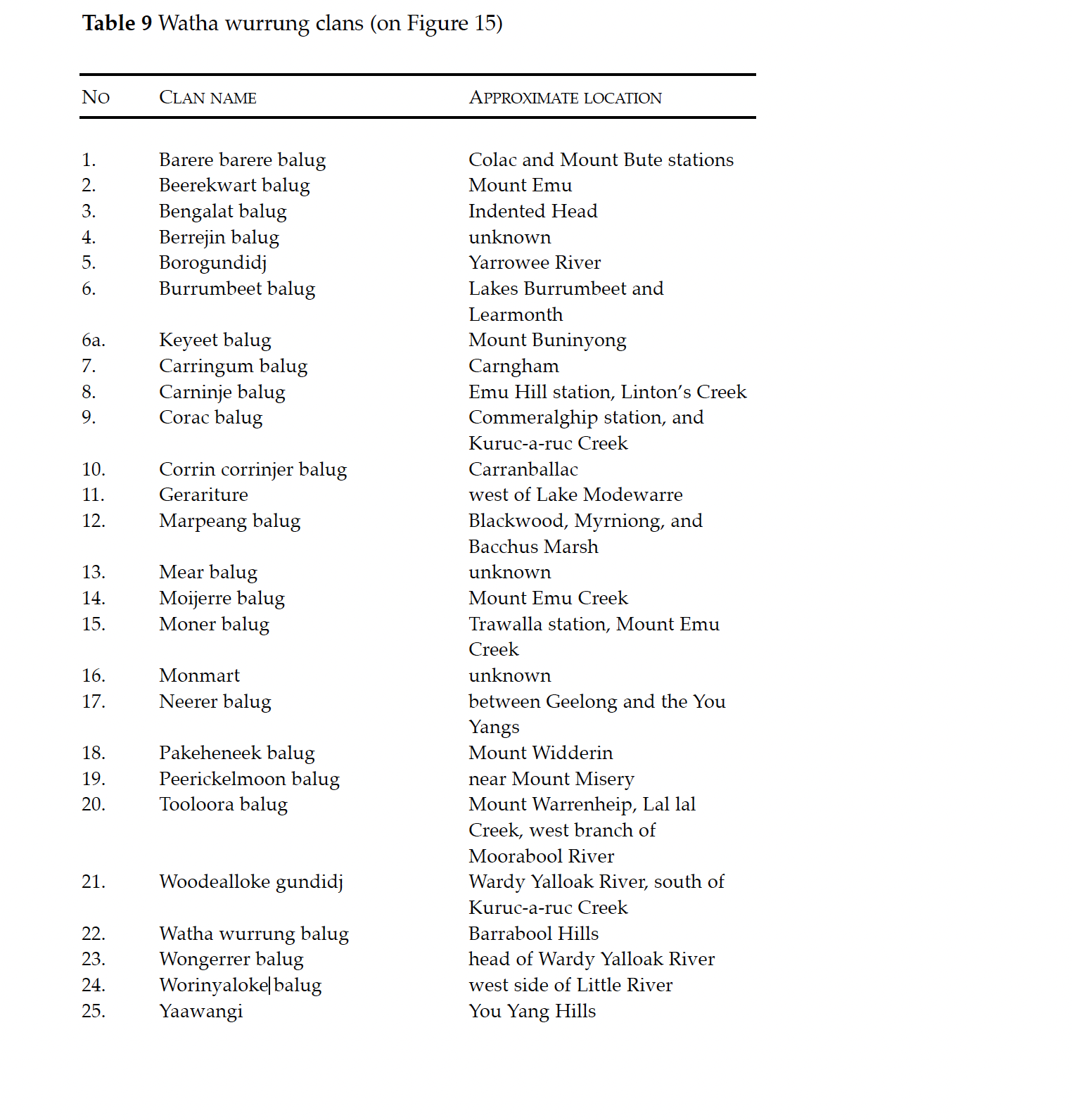
For the Wadawurrung people, whose Country extends across Djilang (Geelong), Ballarat, the Surf Coast, and inland volcanic plains, clans include groups such as the Wathaurong balug, Bengalat balug, Buninyong balug, and Tooloora balug (Clark 1990). The term balug (also written balluk) broadly refers to a clan or group of people connected to a particular place. These clan estates were defined by rivers, wetlands, volcanic plains, and coastal environments, forming the basis of identity, resource management, and cultural responsibility.
Clans, Kinship, and Social Structure
Clans form the foundation of Aboriginal social organisation in Victoria. Each clan is made up of extended families linked through intricate kinship systems that determine relationships, responsibilities, and social roles. These systems govern marriage rules, access to resources, ceremonial obligations, and the transmission of knowledge (Broome 2005).
Kinship extends beyond human relationships to include connections with animals, plants, and ancestral beings. These relationships are structured through moieties and totemic systems, linking individuals to specific species, landscapes, and spiritual responsibilities. For example, within Kulin Nations, moiety systems such as Bunjil (eaglehawk) and Waang (crow) structure social organisation, marriage, and identity (Barwick 1984; Clark 1990).
Language is central to clan identity. The Wadawurrung language, part of the Kulin language family, encodes ecological knowledge, place names, and cultural Lore. Words for landforms, animals, and seasonal changes are embedded within the language, reflecting a detailed understanding of Country. Although disrupted by colonisation, Wadawurrung language is undergoing revitalisation today through community-led programs (Blake & Reid 1998).
Country as Living System
Country, in Aboriginal understanding, is not simply land. It is a living system that includes people, animals, plants, waterways, sky, and ancestral presence. Country is active and relational—it must be cared for through ongoing cultural practice and responsibility (Rose 1996).
On Wadawurrung Country, landscapes shaped by volcanic activity—such as the basalt plains, rivers, and coastal systems—formed the ecological basis for life. These environments supported food systems based on murnong (yam daisy, Microseris spp.), eels, fish, birds, and seasonal plant cycles. Knowledge of these systems was encoded in seasonal calendars based on ecological indicators rather than fixed dates (Gott 2015).
Cultural practices such as fire management (cultural burning) were used to maintain grasslands, promote biodiversity, and sustain food sources. These practices reflect a deep scientific understanding of ecological balance developed over thousands of years (Gammage 2011; Gott 2015).
Family, Lore, and Knowledge Transmission
Family and clan structures are central to the transmission of knowledge. Elders hold cultural authority and are responsible for passing on Lore, history, language, and ecological knowledge to younger generations. This transmission occurs through storytelling, song, ceremony, and direct engagement with Country.
Stories are not simply narratives—they are systems of law and knowledge. They encode information about landscapes, water sources, seasonal changes, and behaviour. Songlines connect different parts of Country, mapping pathways across land and linking clans through shared cultural frameworks (Neale 2017).
On Wadawurrung and broader Kulin Country, these knowledge systems ensured continuity over thousands of generations, maintaining strong connections between people, place, and identity.
First Contact and the Disruption of Clans
The arrival of Europeans in Victoria in the early 19th century brought profound disruption to Aboriginal clan systems. Colonisation introduced new diseases, violence, and dispossession, leading to rapid population decline and the fragmentation of traditional social structures.
The legal doctrine of terra nullius denied the existence of established Aboriginal governance and land ownership systems. As pastoral settlement expanded, clans were displaced from their Countries, losing access to food sources, water, and cultural sites (Broome 2005).
Conflict across Victoria, often referred to as the Frontier or “Silent War,” saw Aboriginal resistance to land seizure and violence. These conflicts, combined with introduced diseases such as smallpox, had devastating impacts on communities (Clark 1990; Broome 2005).
Missions, Reserves, and Family Separation
During the 19th and early 20th centuries, many Aboriginal people were forced onto missions and reserves, including Coranderrk, Framlingham, and Lake Tyers. These institutions imposed strict controls over movement, language, and cultural practices.
Clans were separated, and kinship systems were disrupted. Children were removed from families under assimilation policies, contributing to the Stolen Generations. These processes led to the loss of language, cultural continuity, and connection to Country.
Despite these conditions, Aboriginal communities resisted and maintained cultural identity. Leaders such as William Barak of the Wurundjeri people advocated for land rights and cultural autonomy, demonstrating resilience and leadership during this period (Attwood 2017).
Continuity, Survival, and Cultural Renewal
Despite the impacts of colonisation, Aboriginal clans and families in Victoria have maintained continuity of culture and identity. Today, Wadawurrung and other Traditional Owner groups are actively leading cultural renewal through language revitalisation, land management, and community governance.
Organisations such as the Wadawurrung Traditional Owners Aboriginal Corporation (WTOAC) play a key role in caring for Country, protecting cultural heritage, and re-establishing practices such as cultural burning and on-Country education.
The recognition of Native Title and cultural heritage frameworks represents steps toward acknowledging the enduring connection of Aboriginal peoples to their lands, although these processes remain ongoing (WTOAC 2021).
Country, Memory, and Deep Time
Aboriginal perspectives of Country reflect a deep-time understanding that aligns with scientific interpretations of environmental change. Oral histories describing rising seas, volcanic activity, and ecological transformation correspond with geological evidence dating back thousands of years (Nunn & Reid 2016).
Country holds memory through both story and physical landscape. Volcanic features, waterways, and stone formations are read as living records of creation and transformation. This continuity demonstrates an enduring relationship between people and land that extends far beyond colonial history (Rose 1996).
Conclusion
Clans and Country form the foundation of Aboriginal life in Victoria, shaping identity, governance, and relationships to land and community. These systems, developed over tens of thousands of years, represent sophisticated frameworks of ecological knowledge, social organisation, and cultural Lore.
Colonisation disrupted these systems, causing profound loss and dislocation. Yet Aboriginal communities have maintained resilience, continuing to care for Country and pass down knowledge across generations.
Understanding Wadawurrung and other Victorian clan systems reveals a deeper history—one grounded in relationship, responsibility, and continuity. It is a history that continues to shape the present and future of Australia.
References
Attwood, B. (2017) William Barak and the Coranderrk Station. Melbourne: Monash University Publishing.
Barwick, D. (1984) ‘Mapping the past: An atlas of Victorian clans 1835–1904’, Aboriginal History, vol. 8, pp. 100–131.
Blake, B. & Reid, J. (1998) Wathawurrung Language of the Geelong-Ballarat Area. Aboriginal History.
Broome, R. (2005) Aboriginal Victorians: A History Since 1800. Allen & Unwin, Sydney.
Clark, I. D. (1990) Aboriginal Languages and Clans: An Historical Atlas of Western and Central Victoria 1800–1900. Monash University.
Gammage, B. (2011) The Biggest Estate on Earth: How Aborigines Made Australia. Allen & Unwin.
Gott, B. (2015) ‘Aboriginal use of plants in south-eastern Australia’, Proceedings of the Royal Society of Victoria, vol. 127, no. 2, pp. 64–73.
Neale, M. (2017) Songlines: The Power and Promise. Canberra: National Museum of Australia.
Nunn, P. D. & Reid, N. J. (2016) ‘Aboriginal memories of inundation of the Australian coast dating from more than 7000 years ago’, Australian Geographer, 47(1), pp. 11–47.
Rose, D. B. (1996) Nourishing Terrains: Australian Aboriginal Views of Landscape and Wilderness. Canberra: Australian Heritage Commission.
Wadawurrung Traditional Owners Aboriginal Corporation (WTOAC) (2021) Cultural Fire Strategy for Wadawurrung Country.
Written, Researched and Directed by James Vegter Uncle Reg Abrahams 16/09/2025.
MLA Educational Articles
Sharing the truth of Indigenous and colonial history through film, education, land and community.
Copyright of MLA – 2025
Magic Lands Alliance acknowledge the Traditional Owners, Custodians, and First Nations communities across Australia and internationally. We honour their enduring connection to the sky, land, waters, language, and culture. We pay our respects to Elders past, present, and emerging, and to all First Peoples communities and language groups. This article draws only on publicly available information; many cultural practices remain the intellectual property of communities.