

Ancient Engineering & Environmental Technologies
Introduction
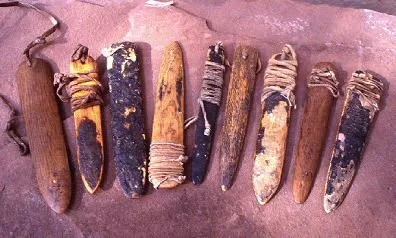
Among the oldest sound instruments in human history is the bullroarer — a carved wooden slat swung through the air to create a deep, resonant vibration. Across Indigenous Australia, including throughout parts of Victoria and the Kulin Nations, the bullroarer carried profound ceremonial, spiritual, and social significance. It was not merely a musical object but a sacred device connected to lore, initiation, spirit communication, and Country itself (McCarthy 1967; Isaacs 1987). Within Wadawurrung, Woi Wurrung, Bunurong/Boonwurrung, Taungurung, and neighbouring nations, sound was understood not simply as entertainment, but as vibration carrying presence, memory, and ancestral connection. The bullroarer formed part of a broader acoustic world in which wind, birds, clapsticks, voice, and ceremony all interacted with landscape and spirit (Barwick 2000).
Deep Time Origins and Indigenous Knowledge Systems
Bullroarers are among the oldest known musical and ceremonial instruments on Earth. Archaeological evidence suggests similar spinning sound instruments existed across ancient cultures worldwide for thousands of years, while Indigenous Australian ceremonial use stretches back countless generations through oral tradition and cultural continuity.
Across Victoria, Indigenous communities developed highly sophisticated understandings of:
sound,
vibration,
materials,
aerodynamics,
and environmental acoustics.
These understandings emerged not through laboratories or written equations, but through close observation of Country across thousands of years. Indigenous technologies were deeply connected to ecology, spirituality, and practical survival. The bullroarer demonstrates how science, culture, and ceremony operated together as an integrated knowledge system.
The Physics and Acoustics of the Bullroarer
The power of the bullroarer lies in its interaction with air, motion, and resonance. When the carved wooden slat spins rapidly on a cord, it rotates while slicing through the air at changing angles. This creates alternating pockets of air pressure that generate low-frequency sound waves. The faster the instrument spins, the more rapidly the vibrations are produced, changing pitch and intensity.
The instrument demonstrates principles of:
aerodynamics,
rotational force,
resonance,
vibration,
and acoustic wave propagation.
The deep humming sound produced by the bullroarer can travel remarkably long distances because low-frequency sounds lose less energy over open landscapes than high-frequency sounds (Ellis 1985). Across the volcanic plains, forests, and river valleys of Wadawurrung and broader Kulin Country, the sound could carry for kilometres, especially during calm evening conditions.
The physical sensation created by the instrument is also important. Low-frequency vibrations can be felt through the body as much as heard through the ears. Modern acoustic science demonstrates that repetitive low-frequency resonance can influence:
emotional states,
spatial awareness,
attention,
group synchronisation,
and psychological focus (Levitin 2006).
This helps explain why ceremonial traditions across the world often use:
drums,
chants,
horns,
didgeridoos,
and vibrating instruments.
The bullroarer was therefore not only symbolic, but psychologically and physically immersive.
Construction and Materials
Bullroarers in south-eastern Australia were commonly made from dense hardwoods, particularly eucalyptus species found across Victoria (McCarthy 1967).
Suitable timbers on Wadawurrung and Kulin Country included:
River Red Gum (Eucalyptus camaldulensis)
Yellow Box (Eucalyptus melliodora)
Messmate (Eucalyptus obliqua)
Grey Box
Stringybark species
These woods were selected because of their:
density,
strength,
acoustic resonance,
durability,
and ability to withstand rotational force.
The bullroarer itself was typically an elongated wooden slat around 20–40 cm long, carefully tapered along the edges to improve aerodynamic spin (Isaacs 1987). Balance was essential. If one side carried too much weight, the instrument would wobble rather than rotate smoothly.
Some instruments were:
hardened near fire,
smoothed with sandstone,
coated with ochre,
or engraved with markings representing clan identity, spiritual symbolism, or ceremonial use.
Cords were traditionally made from:
animal sinew,
twisted plant fibres,
reeds,
grasses,
or possum skin strips.
The apparent simplicity of the bullroarer concealed a sophisticated understanding of material behaviour, rotational balance, airflow, and sound production.
How Bullroarers Were Made
Traditional construction often involved several careful stages:
Selecting Timber
A suitable hardwood branch or slab was chosen, often from naturally fallen timber due to cultural protocols surrounding living trees.
Shaping the Instrument
Stone tools, shell scrapers, and later metal blades shaped the wood into a narrow aerodynamic form.
Smoothing and Balancing
The wood was smoothed using sandstone or abrasive leaves. Correct balance was crucial to ensure stable spinning and clear acoustic vibration.
Fire Hardening
Some bullroarers were lightly heated near fire to strengthen the timber and reduce moisture content.
Decoration
Ochre markings, carved grooves, or symbolic designs could indicate ceremonial purpose, clan identity, or ancestral significance (Isaacs 1987).
Cord Attachment
A small hole was drilled or carved into one end, allowing attachment of fibre cordage.
Using the instrument correctly also required skill. Swinging technique affected:
pitch,
resonance,
vibration intensity,
and directional sound movement.
Experienced ceremonial leaders could manipulate the sound in controlled and highly expressive ways.
Sound and Function
When swung in wide arcs, the bullroarer produced a deep, vibrating hum capable of travelling across large distances. This sound had multiple interconnected functions within Indigenous societies.
Ceremonial Function
Across many regions of Victoria, bullroarers were closely associated with men’s initiation ceremonies and ceremonial lore transmission (Barwick 2000). The sound was often understood as the voice of ancestral beings speaking through Country itself.
The instrument marked sacred ceremonial space and accompanied:
initiation,
dance,
chanting,
teaching,
and ritual performance.
Initiation ceremonies were educational systems in which young men learned:
cultural lore,
kinship obligations,
ecological knowledge,
spiritual responsibility,
and community ethics.
The bullroarer therefore functioned as both ceremonial instrument and educational technology.
Spiritual Communication
The whirring hum was widely believed to embody ancestral presence, making audible the unseen spiritual world (Rose 1992). Rather than separating physical and spiritual reality, Indigenous cosmologies often understood vibration, wind, land, sound, and spirit as interconnected.
Within Kulin traditions, the sound could symbolically echo the presence of Bunjil — the wedge-tailed eagle creator spirit associated with creation, lore, protection, and order (Barwick 2000).
The sweeping movement of the spinning instrument through air mirrored natural forces observed across Country:
wind through trees,
eagle flight,
thunder,
and storm movement.
The bullroarer therefore became a bridge between physical environment and spiritual understanding.
Practical Communication
Historical evidence from parts of Australia suggests bullroarers could also function as long-distance signalling devices used to:
call gatherings,
announce ceremony,
communicate across camps,
or warn of danger (Ellis 1985).
Their acoustic efficiency made them highly effective in open environments.
Men’s Business and Women’s Business
Because of its spiritual potency, the bullroarer’s use was often restricted. Across many parts of Australia, including areas of Victoria, women and uninitiated boys were forbidden from seeing or handling certain ceremonial bullroarers (Barwick 2000). These restrictions reflected systems of cultural responsibility rather than social hierarchy in a Western sense.
In many Indigenous Australian societies:
“men’s business” referred to ceremonial, spiritual, and educational responsibilities held by initiated men,
while “women’s business” referred to equally important knowledge systems and ceremonial responsibilities held by women.
Men’s ceremonial responsibilities often related to:
initiation,
lore,
hunting,
diplomacy,
sacred ancestral knowledge,
and ceremonial leadership.
Women’s ceremonial responsibilities often centred around:
birth,
healing,
kinship,
food systems,
water knowledge,
fertility,
song traditions,
child-rearing,
and spiritual continuity (Berndt & Berndt 1999).
Both systems formed essential parts of cultural governance, balance, and lore transmission. Importantly, ceremonial restrictions varied significantly between nations and communities. Some knowledge remains culturally protected today and is not publicly discussed outside authorised contexts.
Songlines, Sound, and Country
The bullroarer was not merely an instrument — it formed part of broader Songline systems connecting people to landscape, memory, ancestry, and movement through Country.
Songlines functioned as:
oral maps,
ecological memory systems,
spiritual pathways,
and systems of cultural transmission.
The sound of the bullroarer accompanied:
dance,
smoke ceremony,
chanting,
storytelling,
and ritual gatherings.
Its vibration physically connected ceremony to surrounding landscape. As the sound moved through air, trees, plains, and valleys, it reinforced the relationship between people and Country itself.
Within Wadawurrung and Kulin cosmology, sound was deeply connected to:
wind,
birds,
creator beings,
thunder,
and ancestral movement.
The voice of the bullroarer could symbolically represent:
Bunjil travelling through the sky,
ancestral spirits crossing Country,
or the living presence of lore itself.
This demonstrates how Indigenous knowledge systems integrated:
ecology,
psychology,
acoustics,
spirituality,
and cultural lore into a unified worldview.
Wadawurrung and Kulin Nation Connections
For Wadawurrung people, ceremony, song, dance, and oral transmission formed essential parts of maintaining relationship to Country and cultural lore (Clark 1990).
Historical evidence suggests large ceremonial gatherings occurred throughout western Victoria involving:
dance grounds,
body painting,
rhythmic chanting,
trade,
diplomacy,
and cultural exchange (Broome 2005).
These gatherings connected neighbouring nations including:
Wadawurrung,
Woi Wurrung,
Bunurong/Boonwurrung,
Taungurung,
and Djab Wurrung peoples.
Sound played a central role within these ceremonial spaces. The deep resonance of the bullroarer moving across plains and forests would likely have carried immense emotional, spiritual, and cultural significance.
Colonisation and Suppression
Colonisation severely disrupted ceremonial traditions across Victoria. Missions, reserves, and colonial authorities frequently banned or discouraged initiation ceremonies and sacred cultural practices (AIATSIS 2000).
Many ceremonial objects were:
confiscated,
destroyed,
removed to museums,
or stripped of ceremonial context.
Christian missionary systems often viewed Indigenous spirituality as incompatible with colonial order. The suppression of ceremony therefore became a suppression of:
governance,
education,
language,
spirituality,
and cultural continuity (Broome 2005).
Like language loss, the silencing of ceremonial sound profoundly affected cultural transmission across generations.
Revival and Continuity
Today, Indigenous communities across Victoria are revitalising language, ceremony, music, dance, and traditional knowledge systems. Educational programs and cultural workshops may explore:
traditional woodworking,
acoustic knowledge,
Indigenous technologies,
and cultural history.
However, many ceremonial aspects remain protected under cultural authority and are not publicly shared. The revival of instruments such as the bullroarer reflects broader cultural resurgence occurring across Wadawurrung, Wurundjeri, Bunurong, Gunditjmara, and other Victorian communities.
Conclusion
The bullroarer represents a remarkable intersection of:
acoustics,
craftsmanship,
environmental knowledge,
spirituality,
psychology,
and cultural lore.
Its spinning motion transformed air into vibration, yet within Indigenous Victorian traditions that vibration carried far more than sound. It carried ancestral presence, lore, memory, ceremony, identity, and connection to Country. Across Wadawurrung and the broader Kulin Nations, sound itself formed part of governance, education, and spiritual life. The bullroarer demonstrates that Indigenous technologies were sophisticated systems integrating science, ecology, social structure, and cosmology over thousands of years. Today, as communities continue reclaiming and revitalising cultural knowledge, the deep hum of the bullroarer once again echoes across Country — a powerful reminder of resilience, continuity, and living cultural sovereignty.
References
AIATSIS 2000, Settlement: A History of Australian Indigenous Housing and Culture, Australian Institute of Aboriginal and Torres Strait Islander Studies, Canberra.
Barwick, L 2000, ‘Song, Chants and Aboriginal Musical Heritage in Victoria’, Aboriginal History, vol. 24, no. 1, pp. 173–194.
Berndt, RM & Berndt, CH 1999, The World of the First Australians, Aboriginal Studies Press, Canberra.
Broome, R 2005, Aboriginal Victorians: A History Since 1800, Allen & Unwin, Sydney.
Clark, ID 1990, Aboriginal Languages and Clans: An Historical Atlas of Western and Central Victoria, 1800–1900, Monash Publications in Geography, Melbourne.
Ellis, CJ 1985, Aboriginal Music: Education for Living, University of Queensland Press, St Lucia.
Isaacs, J 1987, Australian Dreaming: 40,000 Years of Aboriginal History, Lansdowne Press, Sydney.
Levitin, DJ 2006, This Is Your Brain on Music, Dutton Penguin, New York.
McCarthy, FD 1967, Australian Aboriginal Material Culture, Australian Museum, Sydney.
Rose, DB 1992, Dingo Makes Us Human: Life and Land in an Aboriginal Australian Culture, Cambridge University Press, Cambridge.
Written, Researched and Directed by James Vegter and Uncle Reg Abrahams 16/09/2025
MLA Educational Articles
Sharing the truth of Indigenous and colonial history through film, education, land and community.
Copyright of MLA – 2025
Magic Lands Alliance acknowledge the Traditional Owners, Custodians, and First Nations communities across Australia and internationally. We honour their enduring connection to the sky, land, waters, language, and culture. We pay our respects to Elders past, present, and emerging, and to all First Peoples communities and language groups. This article draws only on publicly available information; many cultural practices remain the intellectual property of communities.