

Ancient Engineering & Environmental Technologies
Abstract
For tens of thousands of years, Indigenous Australians developed highly sophisticated hunting and fishing systems adapted to local ecosystems, seasonal cycles, and environmental conditions. Across Victoria, including Wadawurrung Country and the broader Kulin Nations, hunting and fishing were not merely survival activities but deeply interconnected cultural, ecological, ceremonial, and spiritual practices governed through lore and kinship systems. Indigenous Victorians utilised extensive ecological knowledge of waterways, animal behaviour, seasonal migration, and landscape management to sustainably harvest fish, eels, birds, kangaroo, possums, shellfish, and plant resources. Technologies including spears, nets, traps, boomerangs, canoes, fire management systems, and stone tools demonstrate sophisticated engineering and environmental adaptation developed over thousands of years (Lourandos 1997; Pascoe 2014).
This MLA educational article explores the hunting and fishing techniques of Indigenous Victorians, with particular focus on Wadawurrung Country and the Kulin Nations, while also examining broader Indigenous Australian practices. Integrating archaeology, anthropology, ecology, environmental science, history, and Indigenous studies, the article investigates weapon technologies, fishing systems, cooking methods, ceremonial meanings, sustainability principles, and the impacts of colonisation upon traditional food systems. It argues that Indigenous hunting and fishing represented complex systems of ecological governance and cultural continuity rather than simple subsistence activities.
Introduction: Hunting, Fishing, and Country
For Indigenous Australians, hunting and fishing were inseparable from Country, kinship, ceremony, and environmental responsibility. Food systems operated within highly developed ecological knowledge frameworks refined over thousands of years (Rose 1996).
Across Victoria, Indigenous communities observed:
Seasonal migration patterns
Breeding cycles
Weather systems
Tidal movement
River flow
Plant indicators
Astronomical change
These observations guided when, where, and how resources were harvested sustainably.
Unlike industrial extraction systems, Indigenous hunting and fishing practices were governed through:
Lore
Ceremony
Kinship obligations
Sustainability principles
Respect for animal life and Country
Food gathering therefore formed part of a broader relationship between people, environment, and ancestral law/lore.
Wadawurrung Country and Coastal Food Systems
On Wadawurrung Country across Geelong, the Bellarine Peninsula, Surf Coast, and volcanic plains regions, waterways and coastlines provided rich food systems for thousands of years (Clark 1990).
Major food resources included:
Eels
Fish
Shellfish
Waterbirds
Kangaroo
Possums
Native plants and tubers
Coastal wetlands such as:
Lake Connewarre
Swan Bay
Barwon River estuaries
supported complex fishing and seasonal harvesting systems.
The Wadawurrung people also utilised:
Bark canoes
Fishing spears
Fibre nets
Stone fish traps
Fire management techniques
to harvest food sustainably and efficiently.
Kulin Nations Fishing Systems
Across the broader Kulin Nations, riverine and coastal systems supported sophisticated fishing economies. Indigenous communities developed detailed knowledge of:
Eel migration
Fish breeding
Water flow
Tidal cycles
Seasonal weather systems
Fishing methods included:
Spears
Nets woven from plant fibres
Fish traps constructed from stone and timber
Hand gathering
Canoe fishing
Freshwater systems throughout Victoria supported harvesting of:
Murray cod
Blackfish
Eels
Freshwater mussels
These practices demonstrate highly specialised environmental adaptation (Lourandos 1997).
Spears, Boomerangs, and Hunting Weapons
Indigenous Victorian hunting technologies were diverse and regionally adapted.
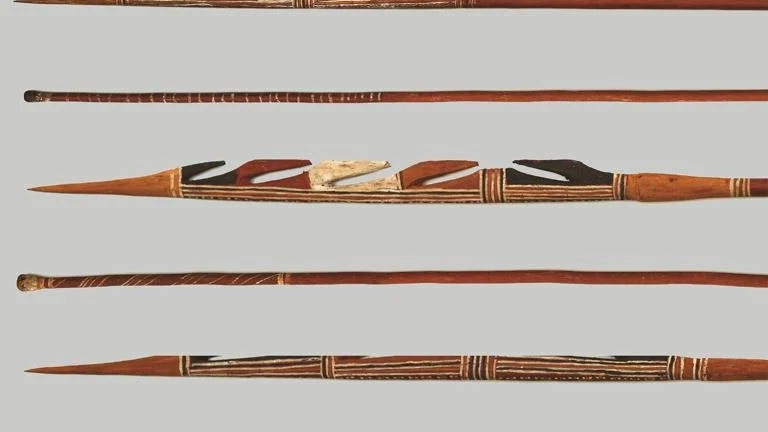
Spears
Spears were among the most important hunting tools. They were commonly made from:
Hardwood shafts
Stone points
Hardened timber tips
Resin bindings
Different spear types existed for:
Fishing
Bird hunting
Large game
Combat and defence
Some fishing spears contained multiple prongs for catching fish in shallow waterways.
Boomerangs
Boomerangs served multiple purposes:
Hunting birds
Striking small animals
Ceremony
Warfare
Music and rhythm
Contrary to popular myth, many hunting boomerangs were not designed to return but to travel in direct trajectories capable of striking prey.
Clubs and Stone Tools
Hunting also utilised:
Clubs
Stone axes
Cutting tools
Knives made from stone flakes
These technologies were highly effective within Australian ecosystems.
Nets, Traps, and Aquaculture Systems
Indigenous Australians developed sophisticated net-making and trapping systems using plant fibres and environmental engineering.
Fibre Nets
Nets were woven from:
Lomandra fibres
Kurrajong bark
Native grasses
Plant string
These nets were used for:
Fishing
Bird trapping
Kangaroo drives
Fish and Eel Traps
Stone and timber traps redirected fish and eel movement into narrow channels where harvesting became easier.
The Gunditjmara eel systems at Budj Bim represent one of the world’s oldest aquaculture systems and demonstrate advanced hydrological engineering (UNESCO 2019).
Across Victoria, smaller fish trap systems also existed along rivers and estuaries.
Fire and Hunting Ecology
Cultural burning formed a major part of Indigenous hunting systems (Gammage 2011).
Low-intensity burns:
Encouraged fresh grass growth
Attracted kangaroo and grazing animals
Improved visibility
Reduced catastrophic fire risk
Increased biodiversity
Fire was therefore both ecological management and hunting strategy.
European settlers often misunderstood these landscapes as “natural wilderness,” failing to recognise that Indigenous communities had actively shaped ecosystems for thousands of years.
Cooking Techniques and Food Preparation
Cooking methods varied across regions and food types.
Earth Ovens and Fire Cooking
Foods were commonly cooked using:
Open fires
Earth ovens
Hot stones
Ash cooking
Smoking techniques
Animals such as kangaroo and possum were often roasted over coals or slow-cooked in earth ovens lined with heated stones.
Fish and Shellfish
Fish were:
Roasted whole
Wrapped in bark or leaves
Smoked for preservation
Shellfish remains accumulated in midden sites that today provide archaeological evidence of long-term occupation and marine harvesting systems (Lourandos 1997).
Plant Foods
Native tubers such as murnong were roasted to soften fibres and release sugars.
Cooking therefore involved extensive botanical and chemical knowledge developed through long-term experimentation.
Ceremony, Spiritual Meaning, and Lore
Hunting and fishing were deeply connected to ceremony and spiritual systems.
Animals often carried:
Totemic significance
Kinship relationships
Ceremonial importance
Ecological responsibilities
Certain animals could only be hunted:
During particular seasons
By specific people
Under ceremonial protocols
Sharing food reinforced:
Community bonds
Reciprocity
Social responsibility
For many Indigenous communities, taking animal life carried ethical obligations requiring respect toward Country and ancestral law/lore.
Sustainability and Environmental Management
One of the most significant aspects of Indigenous hunting systems was sustainability.
Practices commonly avoided:
Overharvesting
Hunting during breeding seasons
Ecological imbalance
Harvesting systems operated through detailed environmental observation accumulated over thousands of years (Pascoe 2014).
This ecological management included:
Rotational harvesting
Seasonal movement
Controlled burning
Respect for breeding cycles
Protection of water systems
Modern environmental science increasingly recognises the sophistication of these systems.
Comparative Indigenous Hunting Systems Across Australia
Different regions across Australia developed unique hunting systems adapted to local environments.
Northern Australia
Communities used:
Dugout canoes
Harpoons
Turtle hunting systems
Mangrove fishing
Desert Regions
Desert communities developed:
Tracking expertise
Water knowledge
Small game hunting systems
Tasmania
Tasmanian Aboriginal communities specialised in:
Coastal shellfish harvesting
Seal hunting
Marine food systems
Despite regional diversity, common principles included:
Sustainability
Kinship responsibility
Ecological knowledge
Seasonal adaptation
Colonisation and the Destruction of Food Systems
European colonisation severely disrupted Indigenous hunting and fishing systems across Victoria and Australia.
Impacts included:
Land dispossession
Wetland destruction
River modification
Fencing and pastoralism
Fire suppression
Decline of native species
Introduced animals and industrial agriculture transformed ecosystems that Indigenous communities had carefully managed for millennia (Reynolds 1987).
Colonial authorities also restricted:
Movement across Country
Traditional hunting
Cultural burning
Fishing access
This contributed to major cultural and nutritional disruption.
Archaeology and Scientific Evidence
Archaeological evidence demonstrates the sophistication of Indigenous Victorian food systems through:
Midden sites
Stone tools
Hearth remains
Fish traps
Bone analysis
Environmental reconstruction
Researchers including Harry Lourandos and Ian Clark have argued that Indigenous Australian societies developed highly organised ecological and social systems long before colonisation (Lourandos 1997; Clark 1990).
Modern archaeology increasingly confirms Indigenous oral histories and environmental knowledge.
Contemporary Revival and Cultural Continuity
Today, Indigenous communities across Victoria continue revitalising traditional ecological knowledge and cultural practices.
This includes:
Cultural fishing programs
Language revitalisation
On-Country education
Cultural burning
Traditional food knowledge
Environmental restoration
Wadawurrung and broader Kulin Nation communities continue strengthening relationships between:
Country
Food systems
Lore
Ecological stewardship
Traditional knowledge remains living and evolving rather than confined to the past.
Conclusion
The hunting and fishing systems of Indigenous Victorians reveal sophisticated ecological knowledge, environmental management, engineering, and cultural governance developed over tens of thousands of years. Across Wadawurrung Country and the broader Kulin Nations, hunting and fishing were not merely subsistence activities but interconnected systems of lore, sustainability, ceremony, and kinship. Weapons, traps, fire management, seasonal harvesting systems, and cooking techniques demonstrate highly developed adaptation to Australian environments. Modern archaeology and environmental science increasingly confirm the sophistication of these systems and their sustainability principles. Although colonisation caused profound disruption to Indigenous food systems and ecological management, Indigenous communities continue revitalising traditional knowledge and cultural practices today. These traditions remind modern Australia that sustainability is not a new idea, but a system of environmental responsibility deeply embedded within Indigenous relationships to Country for thousands of generations.
References
Barwick, D. (1998) Rebellion at Coranderrk. Aboriginal History Monograph.
Broome, R. (2005) Aboriginal Victorians: A History Since 1800. Allen & Unwin.
Clark, I.D. (1990) Aboriginal Languages and Clans. Monash Publications in Geography.
Gammage, B. (2011) The Biggest Estate on Earth. Allen & Unwin.
Lourandos, H. (1997) Continent of Hunter-Gatherers. Cambridge University Press.
Pascoe, B. (2014) Dark Emu. Magabala Books.
Reynolds, H. (1987) The Law of the Land. Penguin.
Rose, D.B. (1996) Nourishing Terrains. Australian Heritage Commission.
UNESCO (2019) Budj Bim Cultural Landscape World Heritage Nomination.
Zola, N. & Gott, B. (1992) Koorie Plants, Koorie People. Koorie Heritage Trust.
Written, Researched and Directed by James Vegter (22 September 2025)
MLA Educational Articles
Sharing the truth of Indigenous and colonial history through film, education, land, and community.
www.magiclandsalliance.org
Magic Lands Alliance acknowledges the Traditional Owners, Custodians, and First Nations communities across Australia and internationally. We honour their enduring connection to the sky, land, waters, language, and culture. We pay respect to Elders past, present, and emerging, and to all First Peoples’ communities and language groups. This article draws only on publicly available information; many cultural practices remain the intellectual property of their respective communities.