

Frontier History in Colonial Early Victoria
The First Settlement of Port Phillip: Collins, Buckley, Fawkner, and the Boonwurrung Coast
MLA Educational Series — Boonwurrung Country: Settlement, Survival, and the Origins of Victoria and Tasmania
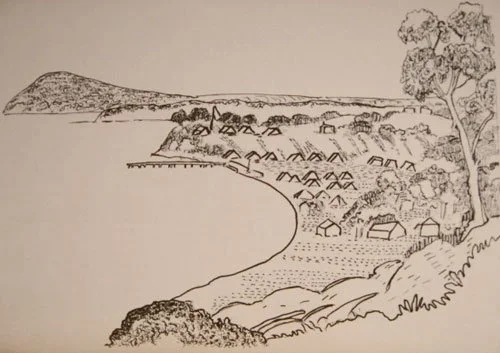
Long before Melbourne was founded in 1835, the first British attempt to settle Victoria began on the Boonwurrung coast at Sullivan Bay, near present-day Sorrento.
In October 1803, Lieutenant-Governor David Collins led a convoy of convicts, marines, and officials from Sydney to establish a new penal colony at Port Phillip under the authority of the British Crown.
This short-lived settlement, lasting only a few months, revealed the harsh realities of colonisation — poor planning, ecological ignorance, and cultural misunderstanding.
Yet within its brief existence lie the stories that shaped the future of two colonies: the escape of William Buckley, the encounters with Boonwurrung people, the career of Collins, and the founding of Hobart after the abandonment of Port Phillip.
The Vision and the Voyage
By 1803, British authorities sought to expand south from Sydney to strengthen their territorial claims against the French and to create new penal outposts.
David Collins, a former Judge-Advocate of New South Wales and founder of the Norfolk Island settlement, was appointed Lieutenant-Governor of a new colony at Port Phillip under orders from Governor Philip Gidley King (Robinson, 1987).
Three ships — HMS Calcutta, Ocean, and several smaller vessels — carried around 300 convicts, 50 marines, and 50 free settlers, including women and children.
They landed at Sullivan Bay on 10 October 1803, naming it after John Sullivan, the British Under-Secretary for War and the Colonies (Shaw, 1966).
The settlers found Boonwurrung Country, part of the Kulin Nation — a place of freshwater springs, coastal woodlands, and rich marine life.
To the Boonwurrung, this coast was part of Yalluk Bulluk Country, extending from the Mornington Peninsula across Western Port and Phillip Island, deeply connected to the creator beings Bunjil (the Eagle) and Waa (the Crow).
The Boonwurrung People and the Land
For the Boonwurrung, the Sorrento–Portsea area was a living coastal network of wetlands, dunes, and shell middens built up over millennia of occupation.
Springs near Sullivan Bay provided fresh water; the nearby tidal flats yielded fish, eels, and shellfish; and the sea was central to economy and ceremony.
At the time of the 1803 landing, Boonwurrung clans under leaders such as Benbow and Bungarie occupied this area seasonally, travelling along the coast between Point Nepean, Cape Schanck, and Western Port.
Early journals recorded Boonwurrung fishing methods using woven nets and spears, and their controlled burning of grasslands — a sophisticated practice misunderstood by colonists as “wildfire.”
Collins’s officers noted that the people were “kindly disposed” but became wary as resources were taken and sacred sites disturbed (Collins, 1804).
Collins’s Settlement and Struggles
The Sullivan Bay site was poorly chosen.
Fresh water was scarce, the soil was sandy and unproductive, and supply ships struggled to reach the remote location.
Collins’s diary reveals mounting despair: “No timber suitable for building, no soil fit for cultivation, no stone for construction.” (Collins, 1804)
Relations with the Boonwurrung became strained as colonists cut trees, shot wildlife, and fenced access to springs.
The marines and convicts were starving; disease and exposure spread.
By December 1803, Collins requested permission to abandon the settlement and relocate to Van Diemen’s Land (Tasmania), where earlier reports promised better conditions.
William Buckley — The Escape and the Long Survival
Amid this turmoil, on 27 December 1803, convict William Buckley escaped from the camp with several companions, heading north along the coast.
The others perished, but Buckley survived, reaching Boonwurrung and Wadawurrung Country near the Bellarine Peninsula.
He was found near Breamlea, holding a broken spear at the burial of a warrior named Murrangurk.
Believing Buckley to be the returned spirit of Murrangurk, the Wadawurrung people took him in and cared for him.
For 32 years, Buckley lived among the Wadawurrung, learning language, custom, and law.
His later account, recorded by John Morgan (1852), describes the deep cultural connection between people and Country — the eel traps, fires, gatherings, and respect for ancestral law.
Buckley’s story remains one of the most remarkable cross-cultural encounters in Australian history.
Fawkner’s Connection and Later Legacy
Among the settlers at Sullivan Bay was a young boy named John Pascoe Fawkner, whose parents were transported convicts.
Fawkner later became one of the key figures in the 1835 Melbourne settlement, alongside John Batman, when the Port Phillip District was resettled after Collins’s failure.
Fawkner’s early memories of deprivation and hardship at Sullivan Bay profoundly influenced his later determination to establish a more permanent and prosperous settlement.
Thus, the story of Melbourne’s founding begins not in 1835, but here, in 1803, among the dunes and tea-tree of Boonwurrung Country.
Abandonment and the Journey to Van Diemen’s Land
In January 1804, Collins evacuated Sullivan Bay, loading his people onto ships and sailing south.
After a stormy voyage across Bass Strait, the expedition arrived at Risdon Cove on the Derwent River, where they joined Lieutenant John Bowen’s earlier settlement.
Collins soon relocated the camp to a better site on the western shore — naming it Hobart Town in honour of Lord Hobart, the Secretary of State for the Colonies.
He became Lieutenant-Governor of Van Diemen’s Land, laying the foundation for modern Hobart (Shaw, 1966).
The failed Port Phillip experiment thus gave rise to Tasmania’s capital — and to the lasting colonial footprint that would spread north again a generation later.
Lieutenant-Governor David Collins — His Life and Legacy
David Collins (1756–1810) was a central figure in early Australian colonisation.
He had served as Judge-Advocate on the First Fleet (1788), worked on Norfolk Island, and was appointed to lead the Port Phillip colony in 1803.
His reports were detailed and pragmatic, yet his leadership was marked by conflict between idealism and imperial constraint.
He wrote of “the greatest reluctance to despoil the natives of their lands” but still carried out the Crown’s orders of occupation.
Collins died in Hobart in 1810, and his name was later given to Collins Street in Melbourne — a symbolic link between the failed Port Phillip settlement and the city that rose from its ashes.
The naming of Collins Street, Sullivan Bay, and Port Phillip thus encodes the layered history of ambition, failure, and dispossession that underpins colonial Victoria.
The Boonwurrung Response and Survival
For the Boonwurrung, the 1803 settlement marked the first major incursion of British authority into their lands.
Though brief, it foreshadowed the devastation of the coming decades: dispossession, disease, and displacement.
Yet oral histories preserved by Boonwurrung descendants recall the encounters at Sullivan Bay — the strange ships, the frightened convicts, and the people who “did not know how to drink from the land.”
Through cultural knowledge, songlines, and story, the Boonwurrung continue to affirm sovereignty over this coastline.
Today, the Bunurong Land Council Aboriginal Corporation (BLCAC) manages heritage sites across the Mornington Peninsula, including Sullivan Bay, recognising it as a place of first contact and continuing story.
Ecological and Cultural Significance Today
Modern environmental studies have revealed the wisdom of Boonwurrung land management.
The springs and wetlands near Sorrento are critical hydrological recharge zones, filtering water into the limestone aquifers that feed the Mornington Peninsula’s ecosystems (DEECA, 2023).
Revegetation and heritage protection projects now seek to restore indigenous plant communities, stabilise dunes, and interpret the cultural history of the area for education and reconciliation.
At Sullivan Bay, archaeology and storytelling coexist: shell middens, fire-hearths, and artefacts lie beside colonial ruins — reminders that two knowledge systems once met here, briefly and profoundly.
Conclusion
The story of Sullivan Bay 1803 is both a beginning and a lesson.
It was the first British settlement in Victoria, the birthplace of Tasmanian colonisation, and the setting for one of Australia’s most extraordinary survival stories.
It is also the first record of contact between the British and the Boonwurrung, whose connection to Country endures despite colonisation.
From Collins’s failure to Buckley’s survival and Fawkner’s later success, the events at Sullivan Bay reveal how ambition, misunderstanding, and resilience shaped the shared history of Victoria and Tasmania.
On these sands, where fresh water meets the sea, the first colony failed — but the land and its people remained, holding the deeper law of Country.
References
Barwick, D. (1998) Rebellion at Coranderrk. Canberra: Aboriginal History Monograph.
Broome, R. (2005) Aboriginal Victorians: A History Since 1800. Sydney: Allen & Unwin.
Bunurong Land Council Aboriginal Corporation (2023) Cultural Heritage of the Mornington Peninsula. Melbourne: BLCAC.
Clark, I.D. & Heydon, T. (2002) Dictionary of Aboriginal Placenames of Victoria. Melbourne: Victorian Aboriginal Corporation for Languages.
Collins, D. (1804) An Account of the English Colony in New South Wales, Vol. 2. London: Cadell & Davies.
DEECA Victoria (2023) Mornington Peninsula Coastal and Wetland Management Plan. Melbourne: Department of Energy, Environment and Climate Action.
Morgan, J. (1852) The Life and Adventures of William Buckley. Hobart: Archibald MacDougall.
Robinson, P. (1987) The British Empire, 1783–1939. London: Macmillan.
Shaw, A.G.L. (1966) A History of the Port Phillip District: Victoria Before Separation. Melbourne: Melbourne University Press.
Written, Researched and Directed by James Vegter (22 September 2025)
MLA
Sharing the truth of Indigenous and colonial history through film, education, land, and community.
www.magiclandsalliance.org
Copyright MLA – 2025
Magic Lands Alliance acknowledges the Traditional Owners, Custodians, and First Nations communities across Australia and internationally. We honour their enduring connection to the sky, land, waters, language, and culture. We pay respect to Elders past, present, and emerging, and to all First Peoples’ communities and language groups. This article draws only on publicly available information; many cultural practices remain the intellectual property of their respective communities.