

Frontier History in Colonial Early Victoria
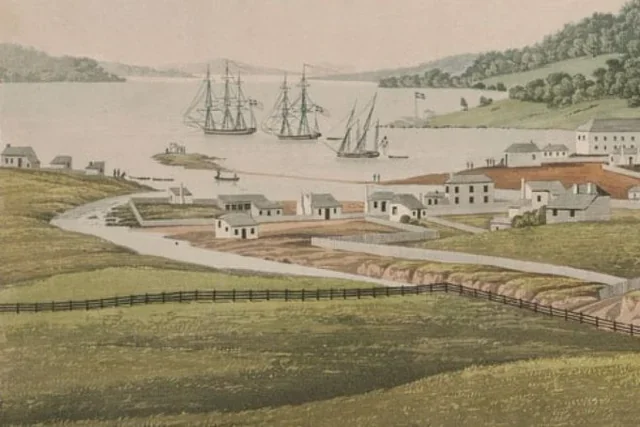
The Journey from Port Phillip to Hobart — The Second Settlement of David Collins, 1804
MLA Educational Series — Van Diemen’s Land: Sovereignty, Survival, and the Making of Tasmania
When Lieutenant-Governor David Collins abandoned Sullivan Bay (Port Phillip) in early 1804, he carried with him the unfulfilled ambitions of Britain’s first attempt to colonise southern Australia.
Within weeks, his convoy of convicts, marines, and settlers reached Van Diemen’s Land (Tasmania), where they founded Hobart Town — a new colonial outpost on the Derwent River.
Hobart was not only a refuge from the failure of Port Phillip; it became a centrepiece of Britain’s strategy to consolidate power in the southern oceans.
Yet the establishment of Hobart also marked the beginning of dispossession for the Mouheneener and other Palawa peoples of southeast Tasmania, whose deep cultural and ecological relationships with Country were quickly overshadowed by the demands of empire.
From Sullivan Bay to the Derwent: The Voyage South
By December 1803, Collins’s Port Phillip settlement was failing.
Supplies were exhausted, fresh water was scarce, and the Boonwurrung coast could not sustain 300 settlers.
Governor Philip Gidley King ordered Collins to relocate to Van Diemen’s Land, where Lieutenant John Bowen had already founded a small post at Risdon Cove in 1803 (Shaw, 1966).
In January 1804, the convoy Ocean, Lady Nelson, and support vessels crossed Bass Strait — an arduous 500-kilometre journey through rough seas and unpredictable winds.
They arrived on the Derwent River on 15 February 1804, entering a sheltered harbour framed by the towering peak later named Mount Wellington (Kunanyi).
Collins immediately saw the potential: deep anchorage, fertile valleys, and abundant timber.
He chose the western shore near Sullivans Cove — named after the same John Sullivan honoured at Port Phillip — as the new site of the settlement.
Here, Hobart Town was born.
Country and the Mouheneener People
Before colonisation, the Mouheneener people, part of the Nuenonne and South East Nations of the Palawa, lived along the Derwent estuary for thousands of years.
They moved seasonally between the river, plains, and coastal islands, hunting wallaby and kangaroo, gathering shellfish, and burning the grasslands in controlled patterns that sustained biodiversity (Ryan, 2012).
The Derwent River — Timtumili Minanya in Palawa Kani language — was a lifeline and spiritual corridor.
Its waters connected mountain and sea, freshwater and saltwater, and held stories of creation beings such as Moinee, the first man, and Dromerdeener, the sky spirit (Plomley, 1966).
When Collins arrived, the Mouheneener observed the ships from the hills above the cove.
Early records describe cautious exchanges — gifts of shells, fish, and spears — but these soon gave way to mistrust as colonists cleared camps and cut sacred trees.
Within months, tension escalated into conflict and tragedy.
Conflict at Risdon Cove, 1804
Before Collins’s arrival, Lieutenant Bowen’s garrison at Risdon Cove had already experienced violent encounters.
In May 1804, soldiers opened fire on a large group of Aboriginal people gathering near the river, killing an unknown number — an event later known as the Risdon Cove Massacre (Shaw, 1966; Ryan, 2012).
When Collins took command, he relocated the settlement to Sullivans Cove partly to escape the “unhappy memory” of Risdon, but the legacy of violence followed.
The Mouheneener people continued to visit Hobart seeking food and trade, yet they were treated as intruders in their own Country.
These events foreshadowed the broader “Black War” of the 1820s–1830s — a devastating frontier conflict that claimed hundreds of Aboriginal lives and reshaped Tasmania’s demography (Boyce, 2008).
The Foundations of Hobart Town
Despite hardship, Hobart Town grew rapidly.
Collins’s priorities were clear: establish order, build food security, and assert Crown authority.
Timber huts and a flagstaff rose above Sullivans Cove; convicts cleared land along the rivulets; and by 1806, the colony had over 500 residents (Robson, 1983).
Collins maintained the strict hierarchy of a penal settlement:
Convicts were assigned to work gangs for agriculture and construction.
Free settlers and marines received rations and small plots of land.
Military rule was absolute — the colony operated under naval discipline.
Trade quickly developed between Hobart and Sydney, and later with London, exporting seal oil, whale products, and timber.
The Derwent River became a major port, attracting whalers, traders, and explorers — many of whom exploited both marine life and Aboriginal people as forced labour.
The Ecology of the Derwent and Early Impacts
The Derwent River estuary was one of the richest ecosystems in Tasmania.
Its tidal flats, seagrass meadows, and wetlands supported eels, flounder, swans, and migratory birds.
For millennia, the Mouheneener had maintained these systems through burning, harvesting, and spiritual care (Jones, 1971).
Within a few years of colonisation:
Deforestation along the riverbanks caused soil erosion.
Whaling stations disrupted marine migrations.
Hunting depleted kangaroo and wallaby populations.
Introduced animals (goats, sheep, and pigs) trampled and polluted waterholes.
In the language of modern ecology, the Derwent became a case study in rapid anthropogenic change — an ecosystem shifted from balance to exploitation in less than a decade.
David Collins: The Man Between Two Colonies
David Collins embodied the contradictions of empire — loyal to the Crown yet troubled by its human cost.
His journals express both admiration for Aboriginal resilience and frustration at the limits of his authority.
He wrote in 1809: “They are not to be subdued by violence, nor conciliated by kindness; for they understand neither as we intend them.” (Collins, 1809)
Collins died suddenly in March 1810, aged 54, and was buried near the settlement he founded.
His death was mourned across both colonies; his leadership bridged Port Phillip, Norfolk Island, and Van Diemen’s Land.
Collins Street in Melbourne was later named in his honour — a symbolic link between the failed settlement at Port Phillip and the success of Hobart.
John Pascoe Fawkner and the Return to Port Phillip
One of the children from the 1803 expedition, John Pascoe Fawkner, later returned to Port Phillip in 1835, leading settlers from Van Diemen’s Land to found what became Melbourne.
In this way, the histories of Hobart and Melbourne are inseparable: both cities were born from Collins’s journey, divided by sea but united in colonial narrative.
Palawa Resistance and Continuity
Despite immense loss, the Palawa peoples of Tasmania endured through resistance, adaptation, and cultural renewal.
Leaders such as Tongerlongeter, Truganini, and Walyer fought fiercely against invasion, while others maintained culture through ceremony, kinship, and story.
Modern language and land-care programs led by the Tasmanian Aboriginal Centre and Pakana Rangers are restoring both Palawa kani language and traditional ecological knowledge, reconnecting people to Country across the Derwent and beyond.
Cultural and Environmental Restoration Today
The Derwent Estuary Program (DEP), begun in 1999, now works in partnership with Aboriginal communities to monitor and heal the river.
Projects include:
Replanting native sedges and riparian vegetation.
Managing industrial pollution from legacy smelters.
Reviving eel and platypus habitats.
Interpreting Aboriginal heritage at Risdon Cove and Sullivans Cove.
For the Mouheneener, caring for the Derwent is more than science — it is an act of sovereignty and cultural healing, restoring balance between people and place.
Conclusion
The Hobart settlement of 1804 stands as both a continuation and a transformation of Collins’s Port Phillip experiment.
It marked the firm establishment of British power in the south, but also the beginning of profound ecological and cultural disruption.
From the fires of Risdon Cove to the birth of Hobart, the story intertwines ambition, survival, and consequence — echoing still in the waters of the Derwent.
Today, as Hobart grows beneath Kunanyi, the voices of the Mouheneener and other Palawa peoples remind us that the land remembers — and that true renewal requires listening to Country once more.
References
Barwick, D. (1998) Rebellion at Coranderrk. Canberra: Aboriginal History Monograph.
Boyce, J. (2008) Van Diemen’s Land. Melbourne: Black Inc.
Broome, R. (2005) Aboriginal Victorians: A History Since 1800. Sydney: Allen & Unwin.
Collins, D. (1809) An Account of the English Colony in New South Wales, Vol. II. London: Cadell & Davies.
Jones, R. (1971) Rocky Cape and the Problem of the Tasmanians. Canberra: Australian Institute of Aboriginal Studies.
Plomley, N.J.B. (1966) Friendly Mission: The Tasmanian Journals and Papers of George Augustus Robinson 1829–1834. Hobart: Tasmanian Historical Research Association.
Robson, L.L. (1983) A History of Tasmania, Vol. 1: Van Diemen’s Land from the Earliest Times to 1855. Melbourne: Oxford University Press.
Ryan, L. (2012) Tasmanian Aborigines: A History Since 1803. Sydney: Allen & Unwin.
Shaw, A.G.L. (1966) A History of the Port Phillip District: Victoria Before Separation. Melbourne: Melbourne University Press.
Tasmanian Aboriginal Centre (2023) Cultural Renewal and Land Management Projects. Hobart: TAC.