

Native Plants, Trees and Flowers
Introduction
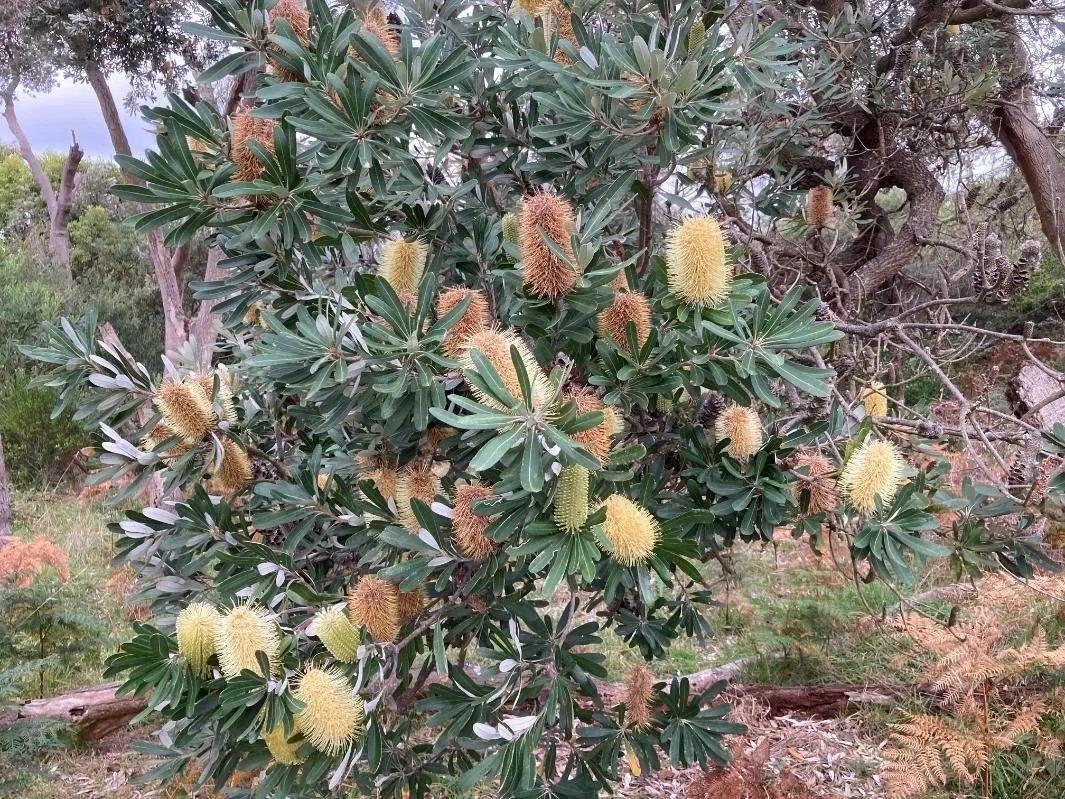
The Banksia is one of Australia’s most distinctive native plants, recognised for its large cylindrical flower spikes, woody seed cones, and deep connection to Australian ecosystems. Found across southern Australia, including the coastal dunes, woodlands, and heathlands of Victoria, Banksias have long held cultural significance for First Nations peoples as sources of nectar, medicine, fire materials, ecological indicators, habitat, and seasonal knowledge (Clarke 2007; Low 1991).
Across Kulin Nations Country, including the lands cared for today by the Wadawurrung Traditional Owners Aboriginal Corporation and the Wurundjeri Woi Wurrung Cultural Heritage Aboriginal Corporation, Banksia formed part of a broader living relationship between people, animals, fire, sky, and Country itself. Its flowering signalled seasonal change, while its nectar attracted birds and insects that sustained wider ecosystems. Its cones opened after fire, revealing one of the most sophisticated regenerative relationships within Australian ecology.
For many Indigenous communities, Banksia represented resilience, continuity, and renewal — a plant deeply connected to the cycles of regeneration that shape Country. Today, as Victoria faces biodiversity decline, habitat fragmentation, and intensifying bushfires, Banksia remains both an ecological keystone and a cultural teacher, reminding communities of the intelligence embedded within Indigenous land management systems.
🌿 What is Banksia?
Banksia belongs to the genus Banksia, named by European botanists after Sir Joseph Banks, who travelled with James Cook in 1770. However, Banksias existed within Indigenous knowledge systems for tens of thousands of years before European naming systems emerged (Clarke 2007).
There are more than 170 species of Banksia across Australia, with several important species occurring in Victoria, including:
Coast Banksia (Banksia integrifolia)
Silver Banksia (Banksia marginata)
Swamp Banksia (Banksia robur)
Hairpin Banksia (Banksia spinulosa) (Costermans 2009)
Banksias thrive in:
Coastal dunes
Heathlands
Open forests
Sandy soils
Their flowering spikes are rich in nectar and attract birds, insects, possums, and bats (Dixon & Barrett 2019).
Cultural and Ecological Roles on Wadawurrung Country
On Wadawurrung Country, Banksias formed part of highly interconnected coastal and woodland ecosystems. Their dense branches provided shelter for birds, reptiles, and small mammals, while their nectar-rich flowers supported pollinators during warmer seasons. The flowering of Banksia often aligned with seasonal transitions, increased bird movement, and the arrival of warmer coastal winds.
Like many Indigenous plants across Victoria, Banksia acted as a seasonal indicator. Observing when the flowers bloomed helped communities understand broader ecological patterns occurring across Country, including the movement of animals, the availability of nearby food resources, and shifts in weather systems.
The plant’s relationship with fire also carried deep cultural meaning. Banksia’s ability to regenerate after burning reflected Indigenous understandings that destruction and renewal are not opposites, but interconnected parts of life on Country. Fire was not viewed simply as a destructive force, but as a process of ecological renewal that sustained biodiversity and balance.
🌾 Traditional Uses and Healing
Nectar and Sweet Drinks
One of the most widespread traditional uses of Banksia was its nectar-rich flowers (Low 1991).
Flower spikes were:
Soaked in water to create a naturally sweet drink
Sucked directly for nectar
Sometimes placed into coolamons or containers to flavour water (Clarke 2007)
The flower heads produce large quantities of nectar, particularly:
Coast Banksia
Silver Banksia
This relationship also connects Banksia to:
Bird migration
Pollinator activity
Seasonal flowering cycles
The flowering of Banksias often indicated:
Warmer seasonal periods
Increased bird activity
Availability of other food resources nearby (Dixon & Barrett 2019)
Medicine and Healing
Banksia also held medicinal and wellbeing uses. Mild infusions made from the flowers and leaves were sometimes used to soothe sore throats or provide relief from fatigue. The smoke from dried cones and branches could also be used in gentle cleansing practices around campsites or ceremonial spaces.
Compared with stronger medicinal smokes produced by eucalyptus or wattle, Banksia smoke was often regarded as softer and more calming. Across many Indigenous Victorian communities, smoke was understood not only as physical medicine, but also as a way of clearing emotional heaviness and restoring balance after illness, grief, or difficult journeys (Atkinson 2002).
The aromatic quality of Banksia smoke connected the plant to broader Indigenous healing systems in which plants, atmosphere, spirit, and Country itself worked together in maintaining wellbeing.
Fire and Banksia Cones
Banksia is one of Australia’s clearest examples of ecological adaptation to fire. Many Banksia species are serotinous, meaning their seeds remain sealed within woody cones until intense heat triggers them to open. Fire therefore becomes part of the plant’s reproductive cycle, stimulating regeneration and new growth (CSIRO 2021).
This ecological relationship closely aligns with Indigenous cultural burning systems developed over thousands of years. Low-intensity cultural burns reduced fuel loads, prevented catastrophic bushfires, encouraged biodiversity, and maintained open woodland systems where Banksias could thrive.
The removal of Indigenous burning practices following colonisation disrupted these ecological balances. Dense undergrowth accumulated, regeneration cycles changed, and many woodland systems became more vulnerable to destructive high-intensity fires (Gammage 2011; Pascoe 2014).
Modern ecological science increasingly recognises that Indigenous fire management sustained Banksia ecosystems successfully for millennia through careful observation and seasonal timing.
🦜 Banksia and Animal Relationships
Banksias are ecological hubs supporting highly interconnected food webs. Their nectar attracts honeyeaters such as the New Holland Honeyeater and Eastern Spinebill, alongside native bees, moths, butterflies, possums, and numerous insects (Dixon & Barrett 2019).
As birds feed upon Banksia nectar, they simultaneously pollinate the flowers, ensuring future seed production and regeneration. Indigenous ecological knowledge recognised these relationships not as isolated biological events, but as part of a living system of reciprocity in which plants, animals, weather, and people all influenced one another.
The flowering of Banksia often corresponded with increased bird activity, while insect movement around the flowers helped indicate shifts in season and weather patterns. These ecological observations formed part of a broader seasonal calendar embedded within Country itself.
🌕 Banksia, Season, and Sky Knowledge
Banksias are also seasonal indicators.
Flowering patterns can correspond with:
Shifts in temperature
Bird movement
Insect emergence
Lunar and moisture cycles (Fuller et al. 2014)
Across southeastern Australia, flowering Banksias often align with:
Warmer winds
Increased nectar-feeding bird activity
Seasonal transitions between dry and cooler periods
Like many Indigenous knowledge systems:
Plants
Animals
Water
Moon phases
Stars
are understood relationally rather than separately.
The flowering of a Banksia is not just botany.
It is a conversation between sky, insect, bird, and soil.
Spiritual and Environmental Significance
Like many Australian native plants, Banksia carried symbolic and spiritual meaning. Its ability to regenerate after fire represented resilience, survival, and transformation. The flowering spikes emerging after difficult environmental conditions reflected the idea that renewal follows hardship — a concept deeply embedded within many Indigenous understandings of Country.
Banksia flowering also signalled periods of ecological abundance and movement. The return of nectar-feeding birds, insects, and warmer winds reinforced the understanding that all life on Country operates through cycles rather than fixed linear systems.
Rather than viewing plants merely as resources, Indigenous knowledge systems understood Banksia as an active participant within living ecological and spiritual networks.
🌏 Banksia in Victoria: Ecology and Colonisation
Scientifically, Banksias are now recognised as keystone pollinator species that support biodiversity, stabilise fragile soils, and maintain habitat systems across coastal and woodland regions (Dixon & Barrett 2019). Their roots assist in preventing erosion, while their flowers provide nectar during periods when other resources are limited.
Since colonisation, however, Banksia ecosystems across Victoria have declined through urban development, grazing, logging, invasive species, and the suppression of Indigenous land management practices. Coastal heathlands and open woodlands were heavily cleared, disrupting pollinator systems and ecological regeneration cycles.
As with many Indigenous plants, Banksia became separated from the cultural systems that once sustained both the plant and the broader landscapes in which it thrived. Increasingly, ecological restoration projects across Victoria now recognise that environmental recovery cannot be separated from Indigenous knowledge and cultural restoration.
Revival and Conservation
Today, Indigenous-led revegetation and cultural restoration projects are helping restore Banksia ecosystems across Victoria. Traditional Owners, Indigenous nurseries, conservation groups, and local councils are reintroducing Banksia woodlands alongside cultural burning knowledge and pollinator habitat restoration. These projects recognise that restoring native plants is not simply about aesthetics or biodiversity. It is about restoring relationships between people, land, fire, water, and ecological memory. Banksia continues to inspire environmental education, cultural programs, habitat recovery projects, art, and storytelling throughout Australia.
🧠 Philosophical Perspectives: Plant Intelligence and Indigenous Knowledge
Michel Foucault — Knowledge and Classification
European science classified Banksia through taxonomy and Latin naming systems. Yet long before colonial classification systems emerged, Indigenous peoples already understood the plant’s flowering cycles, ecological relationships, pollination systems, and regenerative connection with fire. Foucault argued that systems of classification shape what societies recognise as truth (Foucault 1970). Indigenous knowledge systems challenge the assumption that Western science is the only valid framework for understanding ecological intelligence.
Martin Heidegger — Dwelling and Being
Heidegger proposed that humans should “dwell” within the world rather than dominate it (Heidegger 1971). Banksia reflects this relational Indigenous philosophy in which humans are understood as participants within ecological systems rather than owners separated from them. Knowledge emerges through long-term observation, coexistence, and relationship with Country itself.
Indigenous Philosophy: Country as Living Intelligence
In many Indigenous worldviews:
Plants are not “resources”
Country is alive
Ecological systems possess agency and relationship (Rose 1996)
Banksia therefore becomes:
Food
Medicine
Fire knowledge
Habitat
Seasonal calendar
Cultural teacher
all simultaneously.
🌿The Future of Banksia in Cultural Ecology
Banksia embodies resilience and regeneration. Its cones open after fire, its flowers feed ecosystems, and its roots stabilise fragile landscapes shaped by wind, salt, and drought.
For many communities, restoring Banksia is not simply environmental recovery — it is cultural continuity and the return of ecological memory to Country. As climate change intensifies across Australia, Indigenous ecological systems surrounding plants such as Banksia may become increasingly important in shaping future approaches to biodiversity protection, cultural burning, and sustainable land management.
Conclusion
Banksia is far more than a native Australian plant. Across Indigenous knowledge systems, it represents a living relationship between fire and renewal, nectar and pollinators, season and movement, ecology and culture. Its flowering spikes and regenerative cones reveal a sophisticated ecological intelligence long understood by Indigenous peoples across Australia. Like many Indigenous plants, Banksia teaches that landscapes are not passive environments, but living systems of relationship, memory, and adaptation.
To care for Banksia is therefore to care for: regeneration, ecological balance, cultural continuity, and the enduring dialogue between people and Country.
References
Clarke, P.A. 2007, Aboriginal People and Their Plants, Rosenberg Publishing, Sydney.
Costermans, L. 2009, Native Trees and Shrubs of South-Eastern Australia, Reed New Holland, Sydney.
CSIRO 2021, Australian Native Plant Ecology and Fire Adaptation Studies, CSIRO Publishing, Canberra.
Dixon, K. & Barrett, R. 2019, Banksias, Waratahs and Grevilleas, University of Western Australia Publishing, Perth.
Foucault, M. 1970, The Order of Things, Tavistock Publications, London.
Fuller, R., Norris, R. & Trudgett, M. 2014, ‘Indigenous Astronomy and Seasonal Knowledge’, Australian Aboriginal Studies, no. 1, pp. 3–15.
Gammage, B. 2011, The Biggest Estate on Earth: How Aborigines Made Australia, Allen & Unwin, Sydney.
Heidegger, M. 1971, Poetry, Language, Thought, Harper & Row, New York.
Low, T. 1991, Wild Food Plants of Australia, Angus & Robertson, Sydney.
Pascoe, B. 2014, Dark Emu: Aboriginal Australia and the Birth of Agriculture, Magabala Books, Broome.
Rose, D.B. 1996, Nourishing Terrains: Australian Indigenous Views of Landscape and Wilderness, Australian Heritage Commission, Canberra.
Wadawurrung Traditional Owners Aboriginal Corporation 2020, Cultural and Ecological Resources, Victoria.
Wurundjeri Woi Wurrung Cultural Heritage Aboriginal Corporation 2019, Caring for Country Resources, Victoria.
Written, Researched and Directed by James Vegter (22 September 2025)
MLA Educational Articles
Sharing the truth of Indigenous and colonial history through film, education, land, and community.
www.magiclandsalliance.org
Magic Lands Alliance acknowledges the Traditional Owners, Custodians, and First Nations communities across Australia and internationally. We honour their enduring connection to the sky, land, waters, language, and culture. We pay respect to Elders past, present, and emerging, and to all First Peoples’ communities and language groups. This article draws only on publicly available information; many cultural practices remain the intellectual property of their respective communities.