

1800s POLYNESIA
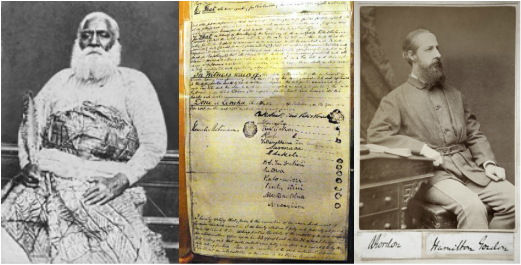
The Deed of Cession, 1874: Fiji, the British Crown and Colonial Power in the Pacific
Fiji Becomes a British Colony
On 10 October 1874, one of the most important political events in Fiji's modern history occurred when Ratu Seru Epenisa Cakobau and twelve other leading Fijian chiefs signed the Deed of Cession, transferring sovereignty over Fiji to Queen Victoria and the British Crown. The British representative who formally accepted the cession was Sir Hercules Robinson, then Governor of New South Wales, illustrating the close administrative connections developing between Britain's Australian colonies and British expansion across the southwest Pacific (Parliament of Fiji 2020; Museum of Archaeology and Anthropology 2018).
The agreement transformed Fiji into a British Crown Colony. Under the new political system, ultimate authority over colonial government, legislation and international relations rested with the British Crown and its representatives. Fiji would remain under British colonial rule for the next 96 years, until independence on 10 October 1970 (Parliament of Fiji 2020).
The Deed of Cession was therefore far more than a ceremonial agreement. It represented a fundamental transfer of political sovereignty and established the legal foundation upon which Britain constructed its colonial administration in Fiji.
Why Did Fijian Chiefs Agree to Cession?
The decision occurred during a period of considerable political instability. Fiji had not historically existed as a single unified kingdom ruled by one monarch. Different vanua, chiefdoms and political alliances exercised authority across different islands and regions.
During the nineteenth century, Bau became increasingly powerful under Cakobau, but his authority remained contested. Powerful political centres such as Rewa resisted Bauan dominance, communities in the mountainous interior of Viti Levu retained considerable independence, and Enele Ma'afu and Tongan political influence had become particularly important throughout eastern Fiji and the Lau Islands (Museum of Archaeology and Anthropology 2026).
European and American traders, missionaries, settlers and plantation owners were also becoming increasingly involved in Fijian affairs. Land transactions, commercial disputes and foreign debts placed additional pressure upon existing political structures.
European settlement increased particularly during the cotton boom associated with disruptions to American cotton supplies during the American Civil War of 1861–1865. As foreign settlement expanded, European settlers increasingly demanded a stable central government capable of recognising property claims, regulating commerce and protecting their interests (UNESCO 2013).
Cakobau also faced significant financial pressure resulting from American claims for compensation following the destruction of property belonging to the United States commercial agent John Brown Williams. These claims became entangled with wider questions about foreign intervention and Fiji's political future (Scarr 1984).
Britain had previously been reluctant to annex Fiji, but by the early 1870s the situation had changed. British officials were increasingly concerned about political instability, European settler interests, competing foreign influence and abuses associated with the Pacific labour trade (Museum of Archaeology and Anthropology 2018).
Cession therefore occurred within a complex environment of Fijian political competition, Tongan influence, European settlement, foreign debt and expanding imperial interests.
What Did the Deed of Cession Actually Do?
The Deed transferred sovereignty over Fiji to Queen Victoria, her heirs and successors. In political terms, this meant that the British Crown claimed ultimate authority over Fiji.
The agreement also addressed the difficult question of land. Existing claims by European settlers had to be investigated, while the rights and interests of Indigenous communities required determination within the emerging colonial legal system (France 1969).
Land became one of the most significant aspects of British policy in Fiji.
Rather than allowing the widespread alienation of Indigenous land that had occurred in several other settler colonies, Governor Sir Arthur Hamilton Gordon sought to preserve substantial iTaukei land ownership and maintain village organisation. Colonial investigations into land tenure eventually contributed to systems designed to record customary ownership through kinship groups and traditional structures (France 1969; Lal 1992).
This did not mean Indigenous sovereignty remained intact.
The distinction is important.
Land ownership and political sovereignty are not the same thing.
Large areas of land remained under Indigenous customary ownership, while ultimate political authority had nevertheless been transferred to the British Crown.
Sir Arthur Gordon and Indirect Rule
Sir Arthur Hamilton Gordon, who became governor in 1875, played an especially important role in constructing Fiji's colonial system.
Rather than completely dismantling Indigenous political structures, Gordon attempted to govern partly through them. Chiefs continued exercising authority within villages and districts, while colonial officials positioned themselves above this system.
This approach became associated with indirect rule.
The Museum of Archaeology and Anthropology at the University of Cambridge describes Gordon's policies as combining protection of Indigenous land and social institutions with the consolidation of British colonial authority (Museum of Archaeology and Anthropology 2026).
Gordon also developed administrative relationships with Fijian chiefs through councils and ceremonial meetings. The institution that became known as the Great Council of Chiefs — Bose Levu Vakaturaga — became an important interface between chiefly leadership and colonial government.
This was an effective imperial strategy because Britain did not need to replace every existing Indigenous institution with European administrators.
Instead, colonial authority could operate partly through existing structures of leadership.
Chiefs remained visible and influential, but the political framework surrounding them had fundamentally changed.
Ceremony as Colonial Power
British colonialism was not exercised solely through soldiers, laws and government offices. It also operated through symbols, ceremonies and relationships.
This was particularly important in Fiji because political authority already involved complex systems of chiefly rank, ceremonial exchange, yaqona, tabua, kinship and reciprocal obligations.
British representatives sometimes participated in these cultural systems rather than simply attempting to abolish them.
Research by Cambridge's Museum of Archaeology and Anthropology shows that Governor Gordon and other colonial representatives participated in ceremonial relationships with chiefs and received objects associated with status and political authority (Museum of Archaeology and Anthropology 2018).
The British Crown could therefore be represented within an existing Fijian political world.
This was a sophisticated form of colonial power.
Instead of saying simply, "your system no longer exists," colonial government could effectively say that existing chiefs and institutions would continue — but within a new hierarchy in which the British Crown possessed ultimate sovereignty.
Was Fiji Peacefully Colonised?
Fiji's annexation is sometimes described as a peaceful cession, particularly when compared with colonies established through large-scale British military invasion.
There is some basis for this description because the Deed itself resulted from negotiation with leading chiefs rather than Cakobau being defeated by a British invasion force.
However, describing Fiji's entire colonisation as peaceful would be misleading.
The thirteen chiefs who signed the Deed did not necessarily exercise recognised authority over every politically independent community throughout the archipelago.
Some communities in the mountainous interior of Viti Levu resisted the extension of colonial authority.
This resistance contributed to the Colo War of 1876.
Historian Robert Nicole argues that resistance during Fiji's early colonial period complicates traditional narratives portraying cession as a simple consensual transfer of sovereignty (Nicole 2010).
Governor Gordon's government used the Armed Native Constabulary and allied Fijian forces to suppress resistance and establish colonial authority throughout areas that had remained comparatively independent (Nicole 2010; Museum of Archaeology and Anthropology 2026).
Fiji's incorporation into the British Empire therefore involved both negotiated cession and armed enforcement.
The Deed of Cession and Britain's Wider Colonial Strategy
The British Empire did not use one single method to acquire territory.
Its strategies varied according to local political circumstances.
British expansion could involve military conquest, settler colonisation, treaties, negotiated cession, protectorates, commercial companies or agreements with existing rulers.
Fiji provides a particularly useful example of negotiated cession followed by indirect rule.
Rather than immediately removing the chiefly system, Britain incorporated much of it into colonial administration. This reduced the number of British officials required to govern the islands and allowed colonial authority to operate through institutions already understood within many communities (France 1969; Lal 1992).
However, British willingness to preserve local institutions should not be confused with political equality.
The fundamental objective of colonial government remained the establishment and maintenance of British sovereignty.
Fiji and Australia: Different Paths to British Sovereignty
The comparison with Australia is particularly significant.
When Britain established the colony of New South Wales in 1788, it did not negotiate an Australia-wide treaty or Deed of Cession with Aboriginal and Torres Strait Islander nations.
British sovereignty was asserted over territories inhabited by peoples who already possessed their own laws, societies, languages, political relationships and systems of land ownership.
Over time, Australian colonial law operated on assumptions that Indigenous land rights were not recognised under British property law. These ideas later became associated with the legal doctrine known as terra nullius.
The Australian High Court's landmark Mabo v Queensland (No 2) decision in 1992 rejected the doctrine of terra nullius as a basis for denying the continuing traditional rights and interests of Indigenous peoples in land. The decision recognised that Indigenous systems of law and land tenure existed before British colonisation and could survive the Crown's acquisition of sovereignty where they had not subsequently been extinguished (High Court of Australia 1992; AIATSIS 2025).
Fiji therefore followed a different colonial pathway.
In Fiji, Britain obtained a formal Deed of Cession signed by recognised Indigenous chiefs.
In Australia, Britain asserted sovereignty without obtaining an equivalent continent-wide agreement from Aboriginal and Torres Strait Islander nations.
This distinction had profound consequences for later relationships between Indigenous peoples, land and colonial law.
A Connection Directly Through New South Wales
The connection between Fiji and Australia was not merely theoretical.
The British representative who accepted Fiji's cession was Sir Hercules Robinson, Governor of New South Wales.
This illustrates how Britain's Australian colonies were becoming bases from which British political, commercial and strategic influence extended further into the Pacific.
Sydney increasingly functioned as an important imperial centre connecting Britain with Pacific shipping, trade, missionary activity and colonial administration.
Fiji consequently became part of a much wider British network linking the Pacific with Australia and New Zealand.
The Pacific as an Imperial Network
By the late nineteenth century, European powers were competing increasingly intensely for influence throughout the Pacific.
Britain already possessed major colonial interests in Australia and New Zealand. France had established power in places including New Caledonia and French Polynesia, while Germany and the United States subsequently expanded their influence across other parts of the Pacific.
Fiji's position in the southwest Pacific made the islands strategically and economically significant.
The Deed of Cession therefore cannot be understood solely as an agreement between Cakobau and Queen Victoria.
It formed part of the wider transformation of the Pacific into territories increasingly claimed, mapped and governed by imperial powers.
British Colonialism, Australia and Sugar
After cession, Fiji became increasingly connected with Australian commercial interests.
One of the most important organisations was the Colonial Sugar Refining Company (CSR), an Australian-based company that established major sugar operations in Fiji during the 1880s.
Sugar became central to the colonial economy.
However, plantations required large amounts of labour.
Governor Gordon did not want the iTaukei population transformed into a permanent plantation workforce because he believed this could destabilise village society and contribute to the destruction of Indigenous communities (Lal 1992).
British colonial authorities therefore looked elsewhere for workers.
They turned to British India.
From the Deed of Cession to Girmit
The first major group of Indian indentured labourers arrived aboard the Leonidas in 1879.
Between 1879 and 1916, approximately 60,000 Indian indentured labourers were transported to Fiji under the indenture system that became known locally as Girmit, derived from the English word "agreement" (Lal 1983; Ali 1979).
Many worked within the sugar economy under extremely difficult conditions.
The development of Indo-Fijian society can therefore be connected directly with the political and economic structures created after British annexation.
A broad historical sequence emerged:
Deed of Cession → British colonial government → plantation expansion → protection of iTaukei village labour → importation of Indian indentured workers → expansion of the sugar industry → development of Indo-Fijian society.
Australia also became part of this network through CSR and wider commercial relationships.
The result was an imperial system connecting Britain, Fiji, Australia and India through government, labour, capital and trade.
One Empire, Different Colonial Methods
The comparison between Fiji and other British colonies demonstrates the adaptability of British imperial strategy.
In Australia, Britain established settler colonies without negotiating a continent-wide treaty of cession with First Nations peoples.
In Aotearoa New Zealand, representatives of the British Crown and many Māori rangatira signed the Treaty of Waitangi in 1840, although major differences between the Māori and English texts and subsequent breaches became central issues in New Zealand history (Waitangi Tribunal 2026).
In Fiji, thirteen leading chiefs signed the Deed of Cession in 1874.
Elsewhere throughout the empire, Britain used protectorates, treaties, chartered companies, military conquest and alliances with existing rulers.
The legal mechanism differed from place to place.
But these different strategies frequently produced a similar outcome: the extension of British political and economic power.
Colonialism Through Law as Well as Warfare
Fiji therefore demonstrates an important principle in understanding colonial history.
Empire did not always arrive through an invading army.
Sometimes it arrived through a document.
A treaty, deed, charter or proclamation could transform relationships between Indigenous peoples and imperial governments.
Law could accomplish what military conquest achieved elsewhere.
But legal agreements existed within unequal political environments shaped by foreign commerce, military technology, debt, missionary activity and international competition.
The Deed of Cession should therefore be understood within this broader context.
It was simultaneously a negotiated political agreement between chiefs and Britain and an instrument through which the British Empire formally acquired sovereignty over Fiji.
The Continuing Significance of the Deed
The Deed of Cession remains significant because it sits at the intersection of Indigenous sovereignty, chiefly authority, customary land ownership and British colonial power.
It established the constitutional basis for 96 years of British colonial government, from 1874 until Fiji achieved independence in 1970.
There is also powerful symbolism in the dates.
10 October 1874 marked Fiji's formal cession to Britain.
Exactly 96 years later, on 10 October 1970, Fiji became an independent state.
The history therefore forms an extraordinary political arc from cession to independence.
Conclusion
The Deed of Cession of 1874 was far more than a document transferring Fiji to Queen Victoria.
It was part of a much larger transformation taking place across the Pacific.
Britain had already established colonies in Australia and New Zealand and was increasingly concerned with protecting commercial routes, settlers and imperial influence throughout the region. Fiji occupied an important position within this expanding network.
Yet Britain did not colonise every country in the same way.
In Australia, sovereignty was asserted without an Australia-wide treaty with First Nations peoples. In New Zealand, the Crown entered the Treaty of Waitangi with many Māori rangatira. In Fiji, sovereignty was transferred through a Deed of Cession signed by thirteen leading chiefs, followed by colonial consolidation and armed suppression of resistance in some regions.
The British colonial system was therefore adaptable.
It could use law, diplomacy, existing Indigenous leadership, commerce, ceremony and military force, depending upon local circumstances.
In Fiji, British administrators preserved substantial Indigenous land ownership and incorporated chiefly institutions into colonial government while simultaneously placing ultimate sovereignty under the Crown. Plantation expansion then connected Fiji to Australia and created demand for Indian indentured labour, producing another profound transformation of Fijian society.
The Deed of Cession therefore helps explain much more than the beginning of British government in Fiji.
It reveals how the British Crown expanded power across the Pacific by adapting its colonial strategy to different peoples, political systems and economic circumstances — creating networks that connected Indigenous lands, colonial Australia, British India and the wider empire.
References
AIATSIS (2025) Mabo Case, Australian Institute of Aboriginal and Torres Strait Islander Studies, Canberra.
Ali, A. (1979) Girmit: The Indenture Experience in Fiji, Fiji Museum, Suva.
France, P. (1969) The Charter of the Land: Custom and Colonization in Fiji, Oxford University Press, Melbourne.
High Court of Australia (1992) Mabo v Queensland (No 2) [1992] HCA 23; 175 CLR 1, High Court of Australia, Canberra.
Lal, B.V. (1983) Girmitiyas: The Origins of the Fiji Indians, Journal of Pacific History, Canberra.
Lal, B.V. (1992) Broken Waves: A History of the Fiji Islands in the Twentieth Century, University of Hawai‘i Press, Honolulu.
Museum of Archaeology and Anthropology, University of Cambridge (2018) 'Displaying Colonial Relations: Fijian Collections at Government House', Museum & Society, 16(2), pp. 279–299.
Museum of Archaeology and Anthropology, University of Cambridge (2026) Chiefdoms: Fiji in the Nineteenth Century, University of Cambridge, Cambridge.
Museum of Archaeology and Anthropology, University of Cambridge (2026) Chiefs & Governors: Fiji in the Colonial Period, University of Cambridge, Cambridge.
Nicole, R. (2010) Disturbing History: Resistance in Early Colonial Fiji, University of Hawai‘i Press, Honolulu.
Parliament of the Republic of Fiji (2020) Fiji During the Deed of Cession, Parliament of Fiji, Suva.
Scarr, D. (1984) Fiji: A Short History, George Allen & Unwin, Sydney.
UNESCO World Heritage Centre (2013) Levuka Historical Port Town, UNESCO, Paris.
Waitangi Tribunal (2026) The Treaty of Waitangi / Te Tiriti o Waitangi, Wellington, Aotearoa New Zealand.
Written, Researched and Directed by James Vegter (October, 2026)
MLA Educational Articles
Sharing the truth of Indigenous and colonial history through film, education, land, and community.
www.magiclandsalliance.org
Copyright MLA – 2025
Magic Lands Alliance acknowledges the Traditional Owners, Custodians, and First Nations communities across Australia and internationally. We honour their enduring connection to the sky, land, waters, language, and culture. We pay respect to Elders past, present, and emerging, and to all First Peoples’ communities and language groups. This article draws only on publicly available information; many cultural practices remain the intellectual property of their respective communities.