

Bunurong/ Boonwurrung Place Names
The Ceremonial Ground of Song, Dance, and Balance
MLA Educational Series — Bunurong/Boonwurrung Country: Ceremony, Law, and the Spirit of Renewal
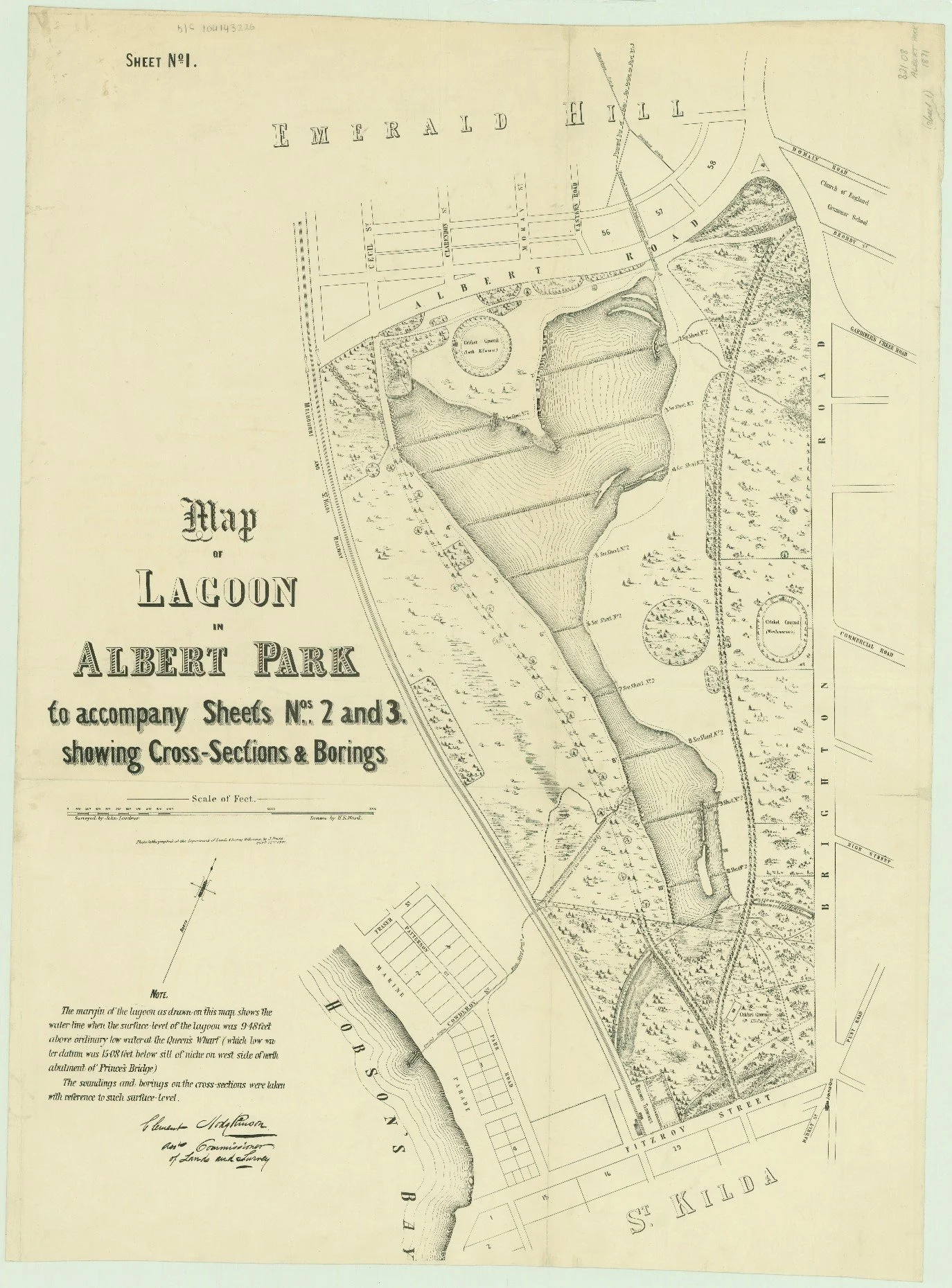
In the heart of Melbourne, beneath the shimmer of Albert Park Lake, lies Ngargee Biik — once one of the most important ceremonial and gathering grounds of the Bunurong/Boonwurrung people of the Kulin Nation. Long before the construction of roads, sports fields, and lakeside boulevards, this area was a vast chain of wetlands, grasslands, and shallow lagoons connecting the Yarra River (Birrarung) to the coast at Euro-Yroke (St Kilda) and Karrum Karrum (Elwood). Here, clans from across the region came together to share law, ceremony, and trade in the open plain known as Ngargee Biik — literally “the ceremonial land” or “the place of song and dance” (Clark & Heydon 2002; Broome 2005). Ngargee Biik was a living centre of cultural governance. It was where political agreements were renewed, marriages arranged, stories told, and ecological knowledge passed through performance. The land itself was the stage, and the rhythm of its water, wind, and birdlife guided the rhythm of the people.
The Meaning of Ngargee Biik
The term Ngargee (also written Ngargee Biik or Ngarigi Bek) comes from the Bunurong/Boonwurrung and neighbouring Woiwurrung languages and translates to “ceremonial ground,” “festival place,” or “corroboree land.” The word combines Ngargee (ceremony, performance) with Biik (Country or earth) (Blake 1991). In cultural terms, it refers not only to a physical site but to the act of renewal itself — when people, land, and ancestors meet through music, story, and dance. Ngargee Biik at Albert Park was one of the largest known such grounds in southern Victoria. Early records describe gatherings where hundreds of people from the Kulin Nations — Bunurong/Boonwurrung, Wurundjeri, Taungurung, and Wathaurong — came together in times of abundance to reaffirm relationships and responsibilities (Clark 1990; Barwick 1998). For the Bunurong/Boonwurrung, the site represented the moral centre of Nairm’s coastal world. It was where the Law of Balance was rehearsed and renewed through performance — where each clan’s story wove into the greater song of Country.
Ecology and the Living Landscape
Before colonisation, the Albert Park area formed part of a wide wetland basin fed by stormwater and the Yarra River floodplain. It supported sedges, reeds, and native grasses that hosted birds, frogs, and small mammals. Seasonal flooding created shallow lagoons and islands that provided both resources and protection, ideal for gatherings that might last weeks or months. The Bunurong/Boonwurrung read these wetlands as a living barometer of environmental health. The presence of swans signalled the breeding season; frog choruses foretold rainfall. The abundance of plant growth marked the right time for ceremony — the land itself announcing when it was ready to host the people. Modern hydrology confirms this natural rhythm: the Albert Park depression acted as a flood sink, regulating the flow of water from higher ground into Nairm, maintaining ecological equilibrium (DEECA 2023). Thus, the same natural cycles that shaped the wetland’s physics also governed its cultural calendar — an interdependence of science and story.
Ceremony, Lore, and Social Exchange
At Ngargee Biik, ceremony was governance. Each gathering followed strict protocols: who could speak, who could dance, when food was shared, and which stories could be told. These events reaffirmed alliances between clans and maintained peace across the Kulin Nations (Broome 2005).
Corroborees combined music, dance, costume, and firelight. The pounding of feet mirrored the heartbeat of Biik; the rhythm of clapsticks echoed the pulse of Nairm’s waves.
Through performance, knowledge of seasons, astronomy, and kinship was transmitted. Songlines spoken here connected inland mountains, the coastal plains, and the islands of Bass Strait — threads in a single law of continuity.
For the Bunurong/Boonwurrung, to dance on Ngargee Biik was to activate the land’s memory. The act itself sustained Country, just as the returning rains sustained the wetlands around it.
Colonial Transformation
European settlement in the 1830s brought drastic change. The lowlands of Ngargee Biik were viewed as swamps to be drained rather than sacred land to be protected. By the 1850s, pastoral use and urban expansion had fragmented the wetlands. The area was fenced, filled, and converted to recreation space (Cannon 1981).
In 1864, engineers constructed an artificial lake — today’s Albert Park Lake — to store water for industry and agriculture. This project erased most visible traces of the original landscape.
The corroboree ground, once resonant with song and smoke, became a European parade ground, later a site for rowing, cricket, and motorsport.
Yet beneath the lawns, the old hydrology persisted. After heavy rain, the ground still floods in the patterns of its ancient lagoons — the earth remembering its former shape.
For the Bunurong/Boonwurrung, this transformation symbolises both loss and continuity: even when altered, Country does not forget.
Cultural Revival and Recognition
Today, the Bunurong Land Council Aboriginal Corporation (BLCAC), in partnership with Parks Victoria, City of Port Phillip, and DEECA, recognises Ngargee Biik as an active cultural landscape.
Cultural mapping has identified surviving artefacts, plant species, and pathways linked to the original ceremonial site (BLCAC 2023).
Reconciliation programs now use the lake as a place of on-Country learning, teaching students about the Law of Flow, wetland ecology, and the meaning of ceremony.
Signage in Bunurong/Boonwurrung language and cultural events at Albert Park continue to restore the site’s identity as a meeting place.
Modern festivals and gatherings held in acknowledgment of Country are, in a sense, the continuation of Ngargee Biik — new forms of the same dialogue between land and people.
Physics and the Lore of Balance
The spiritual principle embodied by Ngargee Biik aligns closely with ecological and physical law.
In both Indigenous knowledge and environmental science, balance arises from exchange.
Wetlands regulate energy through the absorption and release of water; social systems regulate harmony through sharing and ceremony.
Just as modern hydrodynamics studies the flow of matter through open systems, Bunurong/Boonwurrung philosophy teaches that communities remain healthy through open exchange — of goods, words, and song.
This unity between physical and cultural law underpins modern sustainability: caring for ecosystems requires caring for the relationships that sustain them.
Conclusion
Ngargee Biik — the ceremonial land now known as Albert Park — remains one of the most powerful symbols of continuity within Melbourne’s landscape.
Beneath the hum of city life, the old rhythms of gathering and renewal still echo in the lake’s reflection and the call of the black swan.
What was once a sacred ground of song and law now carries those same lessons in new forms — community, dialogue, and care for shared space.
To walk on Ngargee Biik today is to walk on the memory of connection. When we speak its name, we participate in its renewal, ensuring that the land of ceremony continues to teach the art of balance — between past and future, culture and science, land and people.
References
Barwick, D. (1998) Rebellion at Coranderrk. Canberra: Aboriginal History Monograph.
Blake, B. (1991) Wathawurrung and the Colac Language of Southern Victoria. Canberra: Pacific Linguistics.
Broome, R. (2005) Aboriginal Victorians: A History Since 1800. Sydney: Allen & Unwin.
Bunurong Land Council Aboriginal Corporation (2023) Caring for Sea Country: Bunurong Coastal and Cultural Water Plan. Melbourne: BLCAC.
Cannon, M. (1981) Life in the Country: Australia in the Victorian Age 1840–1890. Melbourne: Nelson.
Clark, I.D. (1990) Aboriginal Languages and Clans: An Historical Atlas of Western and Central Victoria 1800–1900. Melbourne: Monash Publications in Geography.
Clark, I.D. & Heydon, T. (2002) Dictionary of Aboriginal Placenames of Victoria. Melbourne: Victorian Aboriginal Corporation for Languages.
DEECA Victoria (2023) Urban Water and Wetland Restoration Policy: Albert Park Lake Catchment. Melbourne: Department of Energy, Environment and Climate Action.
Presland, G. (1994) Aboriginal Melbourne: The Lost Land of the Kulin People. Melbourne: Harriland Press.
Zola, N. & Gott, B. (1992) Koorie Plants, Koorie People: Traditional Aboriginal Food, Fibre and Healing Plants of Victoria. Melbourne: Koorie Heritage Trust.
Written, Researched and Directed by James Vegter (22 September 2025)
MLA
Sharing the truth of Indigenous and colonial history through film, education, land, and community.
www.magiclandsalliance.org
Copyright MLA – 2025
Magic Lands Alliance acknowledges the Traditional Owners, Custodians, and First Nations communities across Australia and internationally. We honour their enduring connection to the sky, land, waters, language, and culture. We pay respect to Elders past, present, and emerging, and to all First Peoples’ communities and language groups. This article draws only on publicly available information; many cultural practices remain the intellectual property of their respective communities.