

Bunurong/ Boonwurrung Place Names
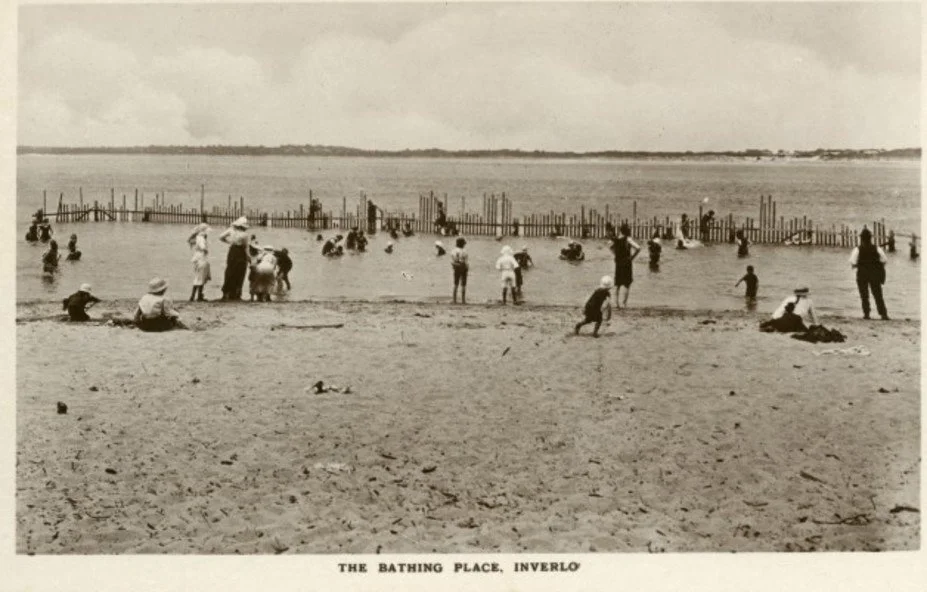
History of Tarwin — Inverloch: The Living Estuary of Bunurong/ Boonwurrung Sea Country
MLA Educational Series — Bunurong Country: Water, Energy, and the Law of Flow
Where the Tarwin River winds from the forested slopes of the Strzelecki Ranges to meet the ocean at Inverloch, the waters broaden into a vast tidal lagoon known today as Anderson Inlet. For the Bunurong (Boonwurrung) people, this place has long been a centre of movement, sustenance, and law — the heart of Sea Country. Known in oral traditions as Tarwin, derived from the Boonwurrung word Darrwin meaning “river of many bends” (Clark & Heydon 2002), this estuary marks the threshold between freshwater and saltwater, land and sea, physical science and spiritual law. Tarwin’s story is one of connection — a living archive where Indigenous cosmology and modern hydrology converge, and where the physics of tides expresses the Bunurong Law of Balance that sustains both Country and culture.
The Meaning of Tarwin and its Setting
The Tarwin River flows southward from the Strzelecki Ranges through fertile floodplains before entering Anderson Inlet near Inverloch (Krow-era). This region lies within the Yallock-Bulluk clan estate, part of the broader Bunurong language group of the Kulin Nation (Clark 1990; Blake 1991). The name Tarwin — or Darowin — translates to “bending” or “snake-like river,” describing its meandering course across the coastal flats. To the Bunurong, however, the river was more than geography: it was a living ancestor whose voice flowed in the sound of running water and whose movement renewed life. Its currents connected inland clans to coastal ones, forming a cultural and ecological corridor for ceremony, food, and trade that has endured across millennia.
Ecology of the Tarwin Estuary
Ecologically, Anderson Inlet is among Victoria’s most dynamic estuarine systems. It functions as a bar-built tidal lagoon, where the interaction between river inflow and ocean tides generates shifting salinity, sediment, and nutrient gradients (DEECA 2023; Parks Victoria 2023). Seasonal changes reshape the sandbar at the inlet mouth, altering tidal exchange and water residence time. To the Bunurong, these movements were read as expressions of Country’s breath — the incoming tide nourishing the land and the outgoing flow offering the land’s return to the sea. This rhythm is mirrored in ceremony, where song and dance re-enact the cyclical flow of energy between elements — a ritual physics that aligns closely with modern systems ecology.
The estuary supports:
Mangroves and saltmarshes that stabilise sediment and nurture juvenile fish.
Seagrass meadows (Zostera muelleri) providing oxygen and habitat for invertebrates.
Migratory bird sanctuaries recognised under the Ramsar Convention, home to the Eastern Curlew and Red-necked Stint.
Freshwater inflows sustaining short-finned eels (kooyang), a keystone species vital to both ecology and culture (Zola & Gott 1992; BLCAC 2023).
Cultural Life and the Law of Water
Before colonisation, Tarwin and Inverloch were vital seasonal gathering grounds. Families built bark shelters and fish traps along the dunes, following ceremonial protocols that governed harvesting and sharing.
The kooyang (eel) held deep significance as both food and spirit messenger. Its migration from inland rivers to the Coral Sea symbolised the Bunurong Law of Return — that all things departing must give back (Presland 1994; Zola & Gott 1992). Eel migration signalled seasonal transitions, guiding ceremonies, trade, and teaching. At the river mouth, smoking ceremonies honoured Warran (the sea) before fishing or travel.
This was not merely ritual: it was a hydrological ethic recognising that water holds memory, spirit, and law — that to disturb its flow is to unsettle the balance of life.
Physics and the Movement of the Estuary
Scientifically, Tarwin estuary dynamics arise from the interplay of tidal oscillation, river discharge, and sediment transport. Hydrodynamic modelling shows that tidal energy enters the inlet as standing waves, while freshwater input shapes salinity and nutrient gradients (DEECA 2023; VandenBerg 1999). To the Bunurong, this same science was observed through sensory knowledge:
The sound of waves signalled the turning tide.
The colour of water revealed the mixing of salt and fresh.
The wind-ripple texture on the surface reflected the breath of Bunjil, the creator.
Thus, Indigenous empirical knowledge and Western physics describe the same processes through different languages — both grounded in observation, rhythm, and feedback. The convergence shows that cultural law and physical law are complementary expressions of the same system of flow.
Colonial Contact and Transformation
By the 1840s, the Tarwin region had become a colonial frontier as pastoral expansion spread from Western Port. The Yallock-Bulluk and neighbouring clans suffered dispossession, conflict, and forced removal under grazing leases (Clark 1995; Broome 2005). Settler records recount massacres along the Tarwin and Powlett Rivers, and by the 1850s the establishment of Anderson’s Run — from which the inlet takes its colonial name — marked the transition from Indigenous stewardship to private property. Wetlands were drained, dunes cleared, and waterways modified for navigation and agriculture. By the early 1900s, the inlet’s natural equilibrium had degraded: fish stocks collapsed, mangrove coverage declined, and sedimentation intensified. For the Bunurong, this was not only ecological harm but a spiritual rupture, severing ancestral relationships that had maintained balance since time immemorial.
Truganini, the Sea, and the Journey of Survival
The Bunurong coast from Western Port to Inverloch also traces the journey of Truganini and her companions in the 1840s after escaping from colonial control in Tasmania. Travelling by canoe and foot across the islands and bays of Bass Strait, they re-enacted ancient routes once possible along the Bassian Land Bridge, which joined Tasmania and the mainland during the last Ice Age (Ryan 2012). Their passage symbolises both continuity and resistance — living proof of the unity of Sea Country that transcends modern political boundaries. The story of Truganini, the tides, and Tarwin thus embodies resilience, belonging, and the enduring relationship between people and moving water.
Modern Conservation and Cultural Renewal
Today, Tarwin / Inverloch / Anderson Inlet forms a core part of the Bunurong Marine and Coastal Parks, jointly managed by the Bunurong Land Council Aboriginal Corporation (BLCAC), Parks Victoria, and DEECA.
Cultural values increasingly guide ecological restoration through programs such as:
Cultural Waterway Assessments blending Bunurong indicators with hydrological metrics.
Dual naming projects reinstating Indigenous names such as Tarwin, Krow-era, and Yallock-Bulluk.
Mangrove and saltmarsh revegetation enhancing natural filtration and biodiversity.
Education programs linking eel cycles, tidal rhythms, and Boonwurrung language learning (BLCAC 2023).
Cultural tourism and truth-telling trails sharing stories of tides, shells, and sea winds.
These initiatives demonstrate that reconciliation begins in practice — through restoring the balance between ecological, social, and spiritual systems.
Cultural Physics: The Law of Flow
In both Boonwurrung philosophy and environmental science, flow is the foundation of life. When flow is free, ecosystems thrive; when obstructed, decay follows. This is the essence of Bunurong Water Law and also of hydrodynamic equilibrium.
The Law of Flow teaches that:
Every action upstream shapes life downstream.
Energy and matter move in cycles — water, spirit, and story always return.
Balance is achieved through exchange, not accumulation.
In physical terms, Tarwin’s stability depends on sediment transport and tidal flushing; in cultural terms, on reciprocity and respect. Both describe the same truth — that harmony is sustained by movement.
Conclusion
Tarwin — Inverloch and Anderson Inlet remain powerful symbols of Bunurong Sea Country, where freshwater meets saltwater and ancient story meets modern science. The river still curves and breathes, reminding all who visit that energy, law, and life are inseparable. Through cultural renewal, ecological restoration, and partnership between Traditional Owners and scientists, Tarwin once again flows with meaning — as both a hydrological marvel and a spiritual teacher. Its enduring message is simple yet profound: when water is cared for, all else finds balance.
References
Barwick, D. (1998) Rebellion at Coranderrk. Canberra: Aboriginal History Monograph.
Blake, B. (1991) Wathawurrung and the Colac Language of Southern Victoria. Canberra: Pacific Linguistics.
Broome, R. (2005) Aboriginal Victorians: A History Since 1800. Sydney: Allen & Unwin.
Bunurong Land Council Aboriginal Corporation (2023) Bunurong Sea Country and Cultural Water Plan. Melbourne: BLCAC.
Clark, I.D. (1990) Aboriginal Languages and Clans: An Historical Atlas of Western and Central Victoria. Ballarat: Monash Publications.
Clark, I.D. (1995) Scars in the Landscape: A Register of Massacre Sites in Western Victoria 1803–1859. Canberra: Aboriginal Studies Press.
Clark, I.D. & Heydon, T. (2002) Dictionary of Aboriginal Placenames of Victoria. Melbourne: Victorian Aboriginal Corporation for Languages.
DEECA Victoria (2023) Marine and Coastal Policy: Bunurong Marine National Park and Anderson Inlet Estuary Management. Melbourne: Department of Energy, Environment and Climate Action.
Parks Victoria (2023) Anderson Inlet and Bunurong Coastal Parks Management Plan. Melbourne: State Government of Victoria.
Presland, G. (1994) Aboriginal Melbourne: The Lost Land of the Kulin People. Melbourne: Harriland Press.
Ryan, L. (2012) Tasmanian Aborigines: A History Since 1803. Sydney: Allen & Unwin.
VandenBerg, A.H.M. (1999) Geology of Victoria. Geological Society of Australia, Special Publication 10.
Zola, N. & Gott, B. (1992) Koorie Plants, Koorie People: Traditional Aboriginal Food, Fibre and Healing Plants of Victoria. Melbourne: Koorie Heritage Trust.
Written, Researched and Directed by James Vegter (22 September 2025)
MLA
Sharing the truth of Indigenous and colonial history through film, education, land, and community.
www.magiclandsalliance.org
Copyright MLA – 2025
Magic Lands Alliance acknowledges the Traditional Owners, Custodians, and First Nations communities across Australia and internationally. We honour their enduring connection to the sky, land, waters, language, and culture. We pay respect to Elders past, present, and emerging, and to all First Peoples’ communities and language groups. This article draws only on publicly available information; many cultural practices remain the intellectual property of their respective communities.