
Bunurong/ Boonwurrung Place Names
History, Isolation, and the Law of Connection
MLA Educational Series — Bunurong/Boonwurrung Country: Islands, Ecology, and the Spirit of Balance
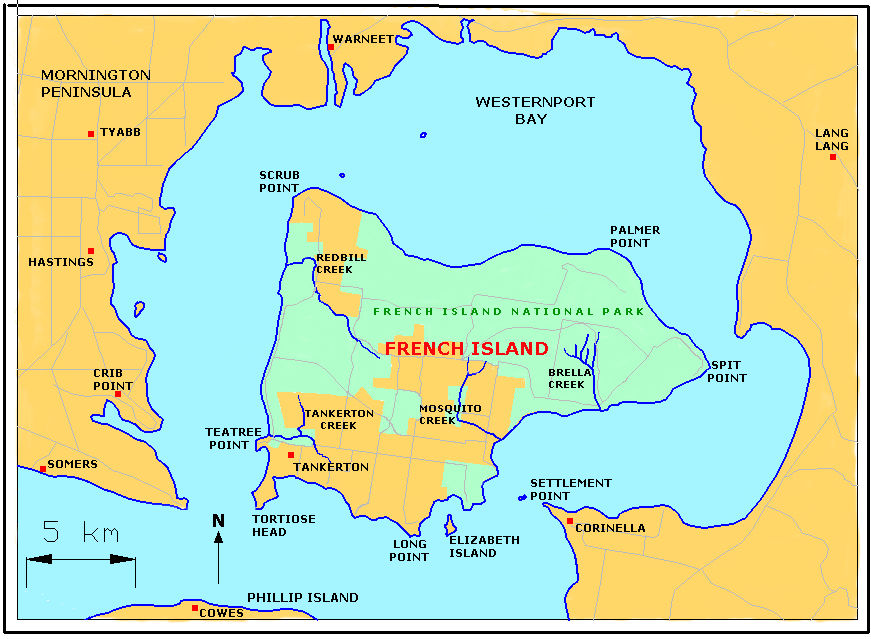
Rising quietly in the centre of Warn’Marrin (Western Port), French Island — known to the Indigenous Bunurong/Boonwurrung peoples as part of Turrung Country — is a place where the boundaries between land and sea blur. Surrounded by tidal mudflats, mangrove forests, and shifting sandbanks, it stands as both an ecological sanctuary and a cultural landmark, shaped by the enduring relationship between water, wind, and law. For the Bunurong/Boonwurrung, the island represents the Law of Balance — the principle that isolation is not separation, but renewal through flow and exchange (Clark & Heydon 2002; Bunurong Land Council Aboriginal Corporation 2023). Though remote and sparsely populated, French Island holds a history that reveals how connection to Country endures across time, from deep prehistory to the modern era.
Geological and Ecological Setting
French Island lies within the tidal basin of Western Port, a drowned river valley formed as sea levels rose following the last Ice Age around 10,000 years ago. Beneath its surface lie ancient sedimentary rocks overlaid with wind-blown sands and coastal clays, shaped by millennia of marine erosion and deposition (VandenBerg 1999). This geological foundation supports a mosaic of landscapes — from mangroves and saltmarsh to open woodland and sandy heath. The surrounding intertidal flats act as natural filters that trap sediment, recycle nutrients, and provide breeding grounds for fish, crabs, and molluscs (DEECA 2023).
The island is home to one of the largest koala populations in Australia and supports a wide diversity of birdlife, including migratory species such as the Eastern Curlew, Bar-tailed Godwit, and Sharp-tailed Sandpiper, all protected under international Ramsar agreements (Parks Victoria 2023). To the Bunurong/Boonwurrung, these ecosystems are threads in a living web that connects sky, water, and land. Each tide, gust, and season is understood as part of Country’s breath — a cycle of giving and renewal that underpins both ecological health and cultural law.
Indigenous History and Sea Country Connections
Long before European exploration, French Island formed part of a vast and dynamic Indigenous Sea Country network linking the Mornington Peninsula, Phillip Island, and the coastal plains of South Gippsland. During the late Pleistocene, when sea levels were much lower, these lands were connected by the Bassian Land Bridge — an open plain stretching across what is now Bass Strait. Rivers, forests, and wetlands once joined the area into a single ecosystem used for hunting, gathering, and travel (Ryan 2012; Clark & Heydon 2002). When rising seas submerged the plain, the islands that remained became sacred markers of memory and continuity.
The Bunurong/Boonwurrung word turrung translates roughly as “standing land” or “rising ground,” reflecting how the island emerges from the sea. Elders describe it as part of the living body of Country — a place of protection, ceremony, and balance. Archaeological findings of shell middens, hearths, and stone tools demonstrate thousands of years of occupation, revealing that the island’s mudflats and wetlands were vital food and resource zones (Presland 1994; Broome 2005). For Indigenous communities, these tidal environments were not boundaries but meeting grounds between the spiritual and physical worlds. The ebb and flow of the tide mirrored the cycle of life, teaching that every gift from the sea must be returned through care and restraint.
Colonial Contact and Transformation
European presence in Western Port began in the early 1800s with sealing, whaling, and naval exploration. Lieutenant James Grant charted the area in 1801 aboard the Lady Nelson, naming the bay “Western Port” due to its position west of Port Phillip Bay. Shortly after, French explorer Nicolas Baudin entered the same waters, and the island was named “French Island” in recognition of his voyage (Cannon 1981). These acts of naming signified the beginning of a new era of dispossession — one that ignored millennia of Indigenous custodianship.
By the 1840s, colonial settlers had begun using the island for grazing cattle and cutting firewood. The introduction of livestock degraded native vegetation, while clearing for salt production and small farms altered the natural hydrology of the wetlands (Barwick 1998; Broome 2005). Indigenous families were gradually displaced through disease, frontier conflict, and forced relocation to government missions at Mordialloc and Coranderrk. Despite this upheaval, oral histories kept the island’s stories alive — recounting it as a place of refuge and remembrance where ancestral law continued quietly through song and story.
In later decades, French Island’s isolation made it useful for colonial authorities seeking containment. It became a site for lime extraction, a quarantine station, and eventually, in the mid-20th century, a prison farm at McLeod Settlement. Ironically, this limited development preserved much of its original landscape, sparing it from the heavy industrialisation seen elsewhere in Victoria.
Isolation and Ecological Resilience
Isolation has proven to be both a challenge and a blessing for French Island. While it contributed to its marginalisation in colonial times, it also protected its ecosystems from many mainland threats. The absence of foxes and rabbits has allowed native mammals such as echidnas, swamp wallabies, and koalas to flourish. Its wetlands remain among the most intact in southern Victoria, hosting mangrove forests, tidal creeks, and saltmarsh communities that are critical for nutrient cycling and coastal protection (Parks Victoria 2023).
Scientists and Indigenous custodians alike describe the island as an ecological memory — a landscape that preserves environmental processes lost elsewhere. The mudflats capture sediment layers that reveal shifts in sea levels and climate over thousands of years. For the Bunurong/Boonwurrung, this knowledge echoes traditional teachings: when land rests, life returns. The island’s endurance through natural and human disruption is seen as proof that balance — if respected — always restores itself.
Law of the Island: Science, Spirit, and Renewal
The Law of Turrung, as expressed through both Indigenous cosmology and ecological science, is the Law of Connection. The surrounding tides function like a breathing organism, inhaling and exhaling nutrients, energy, and stories with every cycle. The mangroves anchor the shoreline against erosion, while seagrass beds purify the water and feed marine life. These processes align with what modern environmental science calls dynamic equilibrium, the principle that ecosystems sustain themselves through constant change and feedback (DEECA 2023).
For Indigenous knowledge holders, this principle has long been embodied in the law of Ngurrara — the balance of movement and respect. The tides and winds are not forces to be mastered but relations to be understood. Every element of the island, from the smallest shell to the largest tree, is part of a law of reciprocity that keeps the world in motion. French Island therefore serves as both a natural classroom and a spiritual guide, teaching that equilibrium is achieved not through control, but through relationship.
Modern Conservation and Cultural Renewal
In 1998, most of French Island was declared a National Park, protecting around 70 percent of its landmass. Today, management is shared between Parks Victoria, the Department of Energy, Environment and Climate Action (DEECA), and the Bunurong Land Council Aboriginal Corporation (BLCAC). This partnership integrates Indigenous ecological knowledge with contemporary conservation science to restore the island’s ecosystems and cultural integrity (BLCAC 2023; DEECA 2023).
Current initiatives include the mapping of sacred and historical sites, reintroduction of Indigenous place names, mangrove and seagrass restoration, and educational programs teaching on-Country awareness to schools and ranger trainees. Cultural tourism programs are also being developed to share the island’s environmental history and the perspectives of Traditional Owners. Through these efforts, French Island is once again becoming a space of dialogue — between ancient law and modern science, between isolation and connection, between history and renewal.
Conclusion
French Island — or Turrung Country — is a landscape that bridges past and present, science and story. It reveals how isolation can preserve wisdom and how renewal arises through respect for flow. From its volcanic foundation to its tidal flats, every feature of the island reflects the principles of balance that have guided Indigenous custodians for thousands of years.
Today, as Bunurong/Boonwurrung Elders work alongside scientists, rangers, and educators, French Island continues to teach the same enduring lesson: that Country is a living system of relationships. Its tides still breathe, its land still remembers, and its spirit still invites us to listen — reminding all who visit that the law of connection endures beyond time.
References
Barwick, D. (1998) Rebellion at Coranderrk. Canberra: Aboriginal History Monograph.
Blake, B. (1991) Wathawurrung and the Colac Language of Southern Victoria. Canberra: Pacific Linguistics.
Broome, R. (2005) Aboriginal Victorians: A History Since 1800. Sydney: Allen & Unwin.
Bunurong Land Council Aboriginal Corporation (2023) Bunurong Sea Country and Cultural Water Plan. Melbourne: BLCAC.
Cannon, M. (1981) Life in the Country: Australia in the Victorian Age, 1840–1890. Melbourne: Nelson.
Clark, I.D. & Heydon, T. (2002) Dictionary of Aboriginal Placenames of Victoria. Melbourne: Victorian Aboriginal Corporation for Languages.
DEECA Victoria (2023) Marine and Coastal Policy: Bunurong Marine Parks and Western Port. Melbourne: Department of Energy, Environment and Climate Action.
Parks Victoria (2023) French Island National Park Management Plan. Melbourne: State Government of Victoria.
Presland, G. (1994) Aboriginal Melbourne: The Lost Land of the Kulin People. Melbourne: Harriland Press.
Ryan, L. (2012) Tasmanian Aborigines: A History Since 1803. Sydney: Allen & Unwin.
VandenBerg, A.H.M. (1999) Geology of Victoria. Geological Society of Australia, Special Publication 10.
Zola, N. & Gott, B. (1992) Koorie Plants, Koorie People: Traditional Aboriginal Food, Fibre and Healing Plants of Victoria. Melbourne: Koorie Heritage Trust.