
Bunurong/ Boonwurrung Place Names
The Swamp Country of Bunurong Law and Water
MLA Educational Series — Boonwurrung Country: Wetlands, Spirit, and the Science of Flow
Long before the straight drains and farmland of today, Koo Wee Rup — once the largest wetland in southern Victoria — was a living, breathing system of water, reeds, fish, and birds.
For the Bunurong (Boonwurrung) people, it was known through language and law as part of Yallock Country — a vast network of rivers, swamps, and floodplains flowing between Western Port, Cardinia Creek, and the Bass Coast.
Koo Wee Rup was not merely a swamp — it was a law-ground and life-source, sustaining clans with food, ceremony, and ecological knowledge. Its transformation under European colonisation into drained farmland remains one of Victoria’s most dramatic environmental changes — but the land still remembers. Today, Bunurong custodians and scientists work together to restore its wetlands, reconnecting ecological physics and cultural spirit across Sea Country.
The Meaning of Koo Wee Rup
The name Koo Wee Rup derives from Boonwurrung language, commonly translated as “plenty of blackfish” or “place of the blackfish swimming” (koo-wee-rup or ku-wirup) (Clark & Heydon, 2002).
In older sources, it also carries meanings like “water of the swamp” or “swamp where people gather,” depending on dialect.
This naming reflects the abundance of freshwater fish (galaxias, eels, and perch) that filled the shallow floodways. It was a place where Bunurong families gathered seasonally to fish, hunt, and perform ceremony.
The prefix koo- often denotes water or fish in southern Kulin languages — linking the name to ecological identity: place, species, and law united in sound.
Country and Hydrology
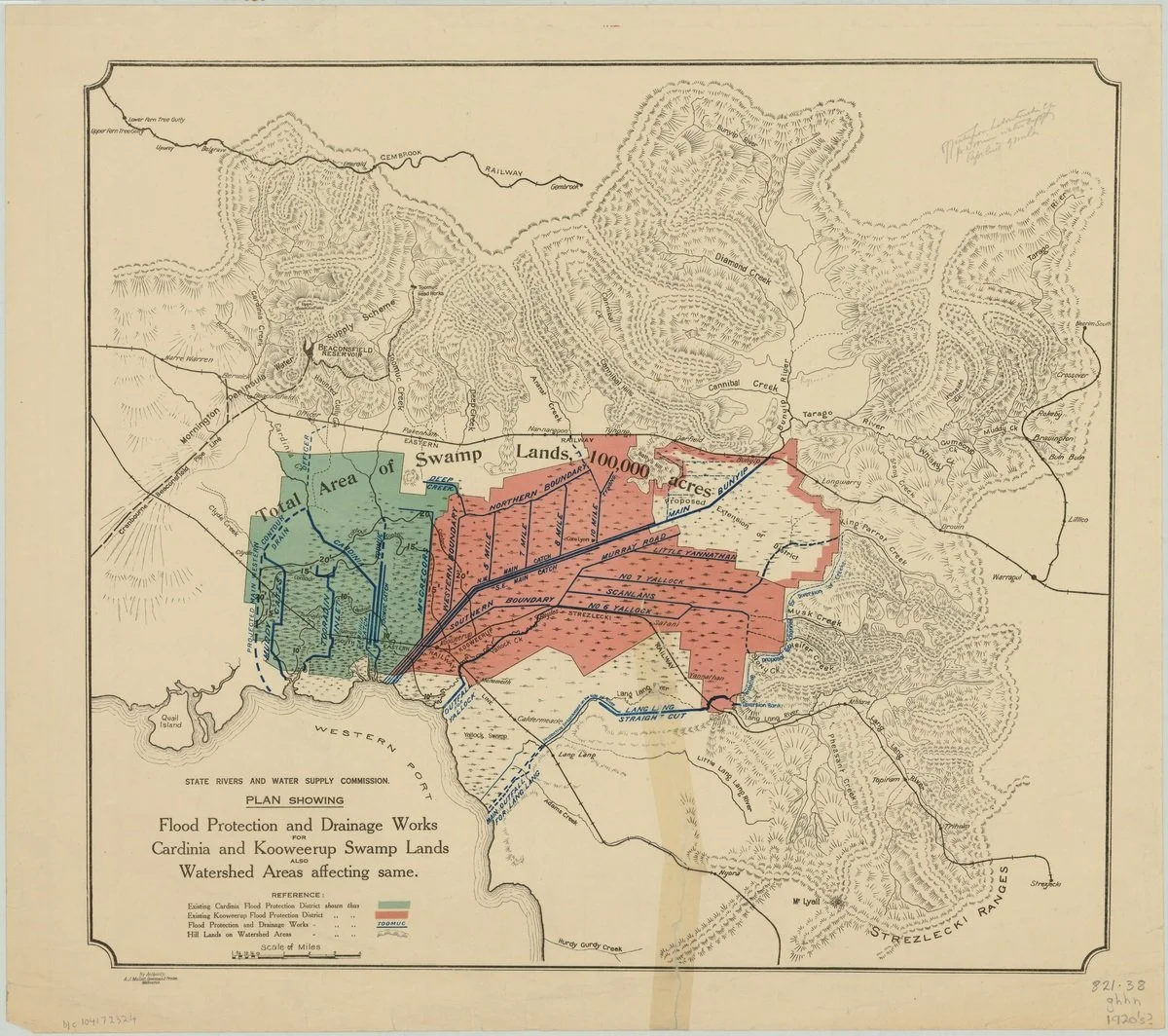
Before colonisation, the Koo Wee Rup Swamp stretched over 40,000 hectares — from the foothills of the Dandenong Ranges and Cardinia Creek down to Western Port Bay.
It was fed by a lattice of rivers — Bunyip River, Lang Lang River, and Yallock Creek — that overflowed seasonally, forming a vast mosaic of reedbeds, tea-tree thickets, and shallow lagoons (DEECA, 2023).
Hydrologically, this system acted as a natural sponge and filtration basin.
It slowed floodwaters from the mountains.
Stored nutrients and sediments.
Filtered freshwater before it reached the sea.
This made Koo Wee Rup one of the most productive wetland systems in southeastern Australia, supporting thousands of birds, amphibians, and fish.
To the Bunurong, these were not just natural processes — they were expressions of Country’s breath.
Each river had its own spirit and flow rhythm, understood through law, observation, and ceremony.
The rising and receding of the swamp marked seasonal transitions, guiding movement, harvest, and story.
Ecology of the Swamp
The swamp teemed with life that sustained both human and non-human communities:
Flora and Habitat
Phragmites australis (common reed) and Baumea sedges formed dense mats along the floodplains.
Melaleuca ericifolia (swamp paperbark) created shaded freshwater pockets.
Water lilies and rushes provided food and nesting material.
Fauna and Resources
Eels (kooyang) were trapped in woven reed nets and smoked for trade.
Blackfish, bream, and perch were staples of freshwater diet.
Swans (kunuwarra), ducks, and herons were hunted seasonally.
Plant fibres were used for weaving baskets, nets, and fish traps (Zola & Gott, 1992).
In Bunurong knowledge, each species had moral and ecological significance — bound by Bunjil’s law of balance: take only what is needed, leave water to flow free.
Modern science confirms the swamp’s ecological genius: its carbon storage, water purification, and biodiversity functions make it a natural infrastructure system far superior to engineered drainage (DEECA, 2023; Parks Victoria, 2021).
Cultural Life and Law of the Water
Koo Wee Rup belonged to the Yallock-Bulluk clan of the Boonwurrung Nation, whose name means “river people” (yallock = river, bulluk = people).
Their ancestral law emphasised reciprocity and flow: water connects all beings — from mountains to sea.
The swamp was a seasonal meeting place, where families gathered from the hills and coast to share ceremony and trade.
Fire was used carefully to manage reed growth, attract game, and maintain open water.
Corroborees and tanderrum (welcome ceremonies) were performed on higher ground near current-day Bayles and Dalmore, acknowledging visitors with song and smoke.
Language and science intertwine here — the very word yallock describes both river and the act of flowing or speaking. In Boonwurrung law, water “speaks” when it moves; silence means imbalance.
Colonisation and Drainage
European settlers arrived in the 1840s, calling Koo Wee Rup “the Great Swamp.”
At first, its size and seasonal flooding prevented farming — but by the 1870s, colonial engineers began major drainage projects to convert wetlands into agricultural land.
The Bunyip Drainage Scheme (1893–1930s) redirected water from the Bunyip and Lang Lang Rivers into straight canals (Cannon, 1981). Thousands of hectares of wetland were destroyed.
Fish populations collapsed.
Bird species like the brolga and bittern disappeared.
Peat soils oxidised and subsided.
Flooding became more severe downstream.
This transformation — one of the largest hydrological alterations in Australian history — reflected the colonial belief in “improving” land by drying it, severing the ecological and spiritual systems that had functioned for millennia.
For the Bunurong, drainage was more than environmental loss — it was the erasure of their law of water.
Ceremonial places and burial sites were buried or destroyed; language describing the water’s voice faded from use.
Physics of Flow and Loss
From a modern hydrological perspective, Koo Wee Rup’s transformation illustrates a profound disruption of physical systems.
Wetlands regulate energy and matter through slow flow, diffusion, and sedimentation — the very processes that sustain stability.
When the swamp was drained, the natural energy gradient was broken: water rushed too fast, causing erosion and nutrient loss.
Indigenous ecological law mirrors this principle.
Bunurong elders describe the land as “breathing through its water.” When water is trapped or forced, the land “holds its breath” — a poetic yet scientifically accurate description of oxygen depletion and soil degradation.
Thus, the physics of Koo Wee Rup — hydrology, diffusion, flow resistance — embodies both ecological truth and cultural wisdom.
Modern Restoration and Cultural Renewal
Since the 1990s, recognition of the swamp’s environmental importance has driven restoration efforts led by the Bunurong Land Council Aboriginal Corporation (BLCAC), Parks Victoria, and local catchment authorities.
Projects include:
Rehabilitating floodplains around Bunyip River and Yallock Creek.
Reintroducing native vegetation and removing invasive willow and blackberry.
Cultural mapping of traditional sites with Bunurong elders.
Education programs linking Bunurong water law with wetland ecology and climate adaptation.
Flood mitigation through wetland restoration, recognising that healthy swamps absorb and release water naturally.
In 2023, Bunurong Traditional Owners began advocating for the dual naming of waterways — reinstating original names like Yallock, Kooweerup, and Lang Lang to reconnect identity with landscape (BLCAC, 2023).
These initiatives mark a shift from domination to collaboration — a scientific and cultural restoration of Country.
Koo Wee Rup in Cultural Law
For the Bunurong, Koo Wee Rup is a living metaphor for balance between abundance and restraint.
It teaches that water — like law — must move freely but not uncontrollably.
Every reed, eel, and current is a participant in the community of life.
In oral tradition, Bunjil (the eagle) watches from above, ensuring people care for water, while Waa (the crow) speaks for the wetlands, reminding all that stories are carried by the wind and water alike.
When water stagnates — physically or morally — life loses its song.
This worldview aligns with modern ecological science: stability emerges through dynamic equilibrium, not through control or stasis.
Thus, the cultural physics of Koo Wee Rup remains both a moral and environmental lesson for future generations.
Conclusion
Koo Wee Rup stands as a story of both loss and renewal — once a vast living wetland, later drained and silenced, now slowly breathing again.
For the Bunurong people, it remains a law-ground of water, where ecology and spirituality converge.
Through restoration, language revival, and truth-telling, the swamp’s ancient function — to flow, filter, and feed — is returning.
In both Indigenous knowledge and environmental science, Koo Wee Rup embodies the same truth:
when water is allowed to move with respect, the land and its people heal together.
References
Barwick, D. (1998) Rebellion at Coranderrk. Canberra: Aboriginal History Monograph.
Blake, B. (1991) Wathawurrung and the Colac Language of Southern Victoria. Canberra: Pacific Linguistics.
Bunurong Land Council Aboriginal Corporation (2023) Bunurong Cultural Waterways and Wetland Management Strategy. Melbourne: BLCAC.
Broome, R. (2005) Aboriginal Victorians: A History Since 1800. Sydney: Allen & Unwin.
Cannon, M. (1981) Life in the Country: Australia in the Victorian Age, 1840–1890. Melbourne: Nelson.
Clark, I.D. & Heydon, T. (2002) Dictionary of Aboriginal Placenames of Victoria. Melbourne: Victorian Aboriginal Corporation for Languages.
DEECA Victoria (2023) Restoring Victoria’s Wetlands and Waterways: Kooweerup and Bunyip River Catchment Plan. Melbourne: Department of Energy, Environment and Climate Action.
Parks Victoria (2021) Western Port and Kooweerup Swamp Conservation Management Plan. Melbourne: Parks Victoria.
Presland, G. (1994) Aboriginal Melbourne: The Lost Land of the Kulin People. Melbourne: Harriland Press.
Zola, N. & Gott, B. (1992) Koorie Plants, Koorie People: Traditional Aboriginal Food, Fibre and Healing Plants of Victoria. Melbourne: Koorie Heritage Trust.
Written, Researched and Directed by James Vegter (22 September 2025)
MLA
Sharing the truth of Indigenous and colonial history through film, education, land, and community.
www.magiclandsalliance.org
Copyright MLA – 2025
Magic Lands Alliance acknowledges the Traditional Owners, Custodians, and First Nations communities across Australia and internationally. We honour their enduring connection to the sky, land, waters, language, and culture. We pay respect to Elders past, present, and emerging, and to all First Peoples’ communities and language groups. This article draws only on publicly available information; many cultural practices remain the intellectual property of their respective communities.